About Hylophilus flavipes Lafresnaye, 1845
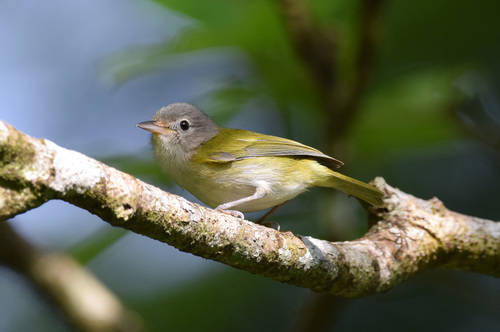
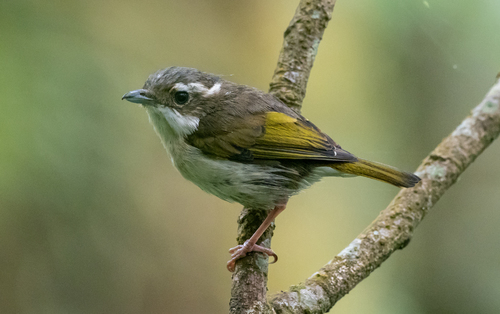
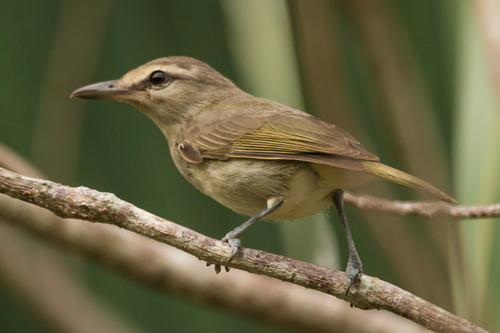
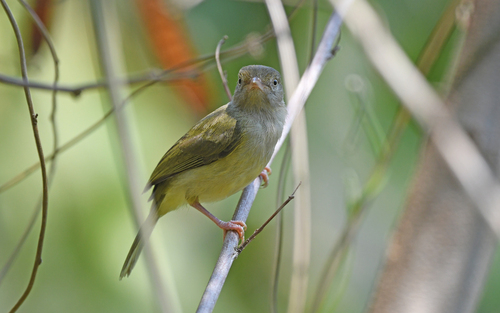
The scrub greenlet (Hylophilus flavipes Lafresnaye, 1845) measures 10.5 to 12.5 cm (4.1 to 4.9 in) in length and weighs 9.5 to 14 g (0.34 to 0.49 oz). Both sexes have identical plumage. For the nominate subspecies H. f. flavipes, adults have dull olive-green crowns, napes, and upperparts, with a slightly lighter rump. The sides of the head are pale gray. The flight feathers of their wings are mostly blackish gray: thin greenish edges line the outer webs of the primaries and secondaries, while tertials have wider greenish yellow edges. The tail is greenish gray. The chin, throat, and breast are whitish gray, and the belly is pale yellowish. Nominate adults have a whitish or gray iris, a grayish or grayish pink upper mandible (maxilla), a more pink lower mandible, and bluish or dusky pink legs and feet. Juveniles have essentially the same plumage as adults, but have a dark bill and dark iris. The other recognized subspecies differ from the nominate and one another as follows. H. f. viridiflavus has yellowish olive crown, nape, upperparts, and tail; wing coverts and secondaries are yellowish olive, and primaries are blackish with yellowish olive edges on their outer webs. Its chin is dull white, throat and upper breast are pale yellowish olive, and the rest of the underparts are pale yellow. It has a yellowish white to gray iris, brown maxilla, paler mandible, and pale brown to yellowish brown legs and feet. H. f. xuthus is similar to viridiflavus, but has darker green upperparts, buffier underparts, darker flanks, and a yellowish white iris. H. f. melleus has a darker crown and back, and buffier underparts than the nominate, with a darker upper breast than lower breast. It has an olive brown bill with an olive-buff base on the mandible, and olive-brown legs and feet. H. f. galbanus has buffier breast and flanks, and a whiter abdomen than the nominate, with a white iris. H. f. acuticaudus is duller overall than the nominate, with dull citrine upperparts and deep olive-buff underparts, and a dark iris. H. f. insularis has a grayer head than the nominate, with deep grayish olive upperparts and deep olive-buff underparts. It has a dark brown iris, black maxilla, grayish pink mandible, and pinkish gray legs and feet. The subspecies of the scrub greenlet have the following distribution ranges. H. f. viridiflavus ranges from the southern end of the Gulf of Nicoya in Costa Rica, south along the Pacific slope into Panama as far as Panamá Province, and also occurs on the Caribbean slope of Panama around the Canal Zone. H. f. xuthus is found only on Coiba Island off the coast of southwestern Panama. H. f. flavipes is found in northern Colombia, along the Caribbean coast east to Santa Marta, and extends south through the Magdalena River valley. H. f. melleus occurs in Colombia's Serranía de Macuira, located in extreme eastern La Guajira Department. H. f. galbanus ranges from the Santa Marta area of northern Colombia east (excluding the tip of Guajira Peninsula) into northwestern Venezuela as far as Barinas and Portuguesa states, and extends south in Colombia's Eastern Andes to northwestern Meta Department. H. f. acuticaudus is found in northern Venezuela from eastern Zulia east to Sucre, and south to Apure, northern Amazonas, and northeastern Bolívar; it also occurs on Margarita Island. H. f. insularis is found only on Tobago. The scrub greenlet occupies different tropical zone landscapes across its range. The two Central American subspecies occur primarily in low dense scrub, and also inhabit oil palm plantations, mature secondary forest, bamboo stands, and tree-dotted pastures and clearings. In elevation, they reach 900 m (3,000 ft) in Costa Rica, and are mostly found below 450 m (1,500 ft) in Panama. The three mainland South American subspecies also occur in arid scrublands, especially those regenerating with trees, in addition to dry to moist semi-deciduous and deciduous forest and woodlands, and gallery forest. In elevation, they reach 1,000 m (3,300 ft) in Colombia, 1,200 m (3,900 ft) north of the Orinoco River in Venezuela, and 500 m (1,600 ft) south of the Orinoco River. The subspecies H. f. insularis on Tobago prefers taller scrub and forest edges, and occurs mostly below 500 m (1,600 ft).