About Hylophilus decurtatus (Bonaparte, 1838)
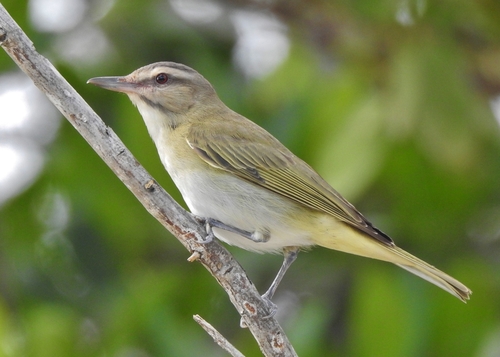
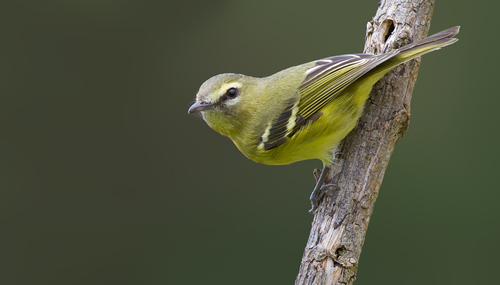
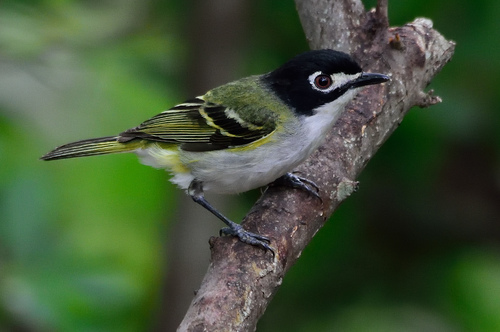
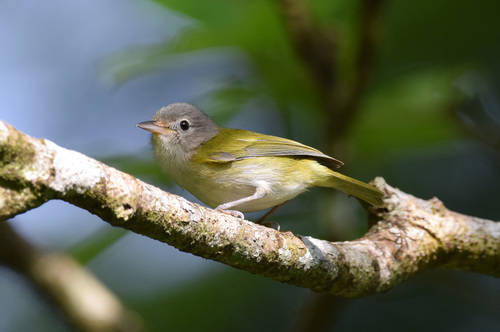
Hylophilus decurtatus, commonly known as the lesser greenlet, is 9.4 to 10.2 cm (3.7 to 4.0 in) long and weighs 6.6 to 10.3 g (0.23 to 0.36 oz). The sexes share identical plumage. Adults of the nominate subspecies have a gray-blue crown and upper face, grayish lores, a whitish eye-ring, and often a pale stripe above the lores. Their upperparts are olive-green, with a lighter shade on the rump. The primary and secondary flight feathers of their wings are dark grayish, with bright greenish outer webs; their tail is grayish green. Underpart colors are: whitish chin, pale gray throat, very pale lemon-yellow breast, whitish belly, and greenish yellow flanks and vent. Their underwing coverts are yellow. The species' other subspecies differ from the nominate and each other as follows: P. d. brevipennis has a pure gray crown, pale lores and ear coverts, grass-green back, and brighter green flanks than the nominate. P. d. dickermani has a darker, duller green back than the nominate, a white throat, little or no white on underparts, and extensive green on the flanks. P. d. phillipsi has a crown that is sometimes tinged brown, duller and grayer upperparts than the nominate, and paler flanks and undertail coverts. P. d. darienensis has an olive wash on its crown, which matches the color of this subspecies' back and the nominate's back. P. d. minor has brighter upperparts than the nominate, with darker greenish yellow flanks. All subspecies have a dark brown iris, a dark gray maxilla, a pale gray to horn-colored mandible, and pale gray or leaden blue legs and feet. The subspecies of the lesser greenlet are distributed across the following ranges: P. d. brevipennis occurs in eastern Mexico starting from southeastern San Luis Potosí. P. d. dickermani occurs in southeastern Mexico, excluding the Yucatán Peninsula. P. d. phillipsi occurs on Mexico's Yucatán Peninsula and in northern Belize. P. d. decurtata ranges from Guatemala and southern Belize south along both slopes through Central America to the Panama Canal area. P. d. darienensis ranges from the Panama Canal area east into northwestern Colombia, reaching as far east as Santander Department. P. d. minor ranges along the Pacific slope of western Colombia, south through Ecuador and just into far northwestern Peru's Tumbes Department. The lesser greenlet lives in a variety of tropical zone landscapes, including evergreen forest, deciduous forest, gallery forest, and secondary forest. Its maximum elevation range differs by region: from sea level to 1,400 m (4,600 ft) in northern Central America, 1,500 m (4,900 ft) in Costa Rica, 800 m (2,600 ft) in Colombia, 1,100 m (3,600 ft) in Ecuador, and 400 m (1,300 ft) in Peru.