About Hylophilus aurantiifrons Lawrence, 1861
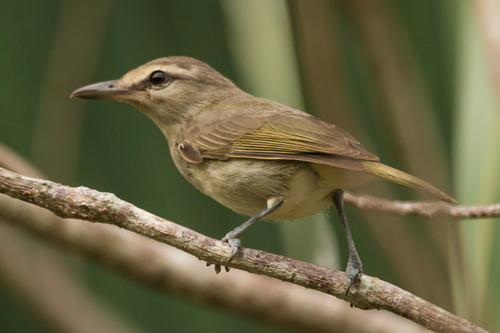
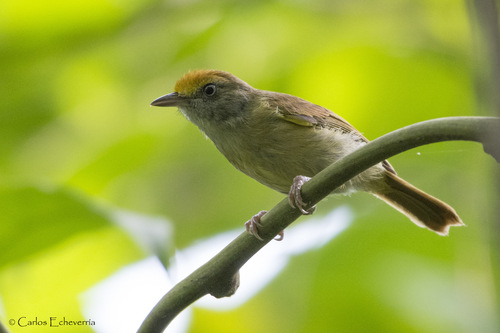
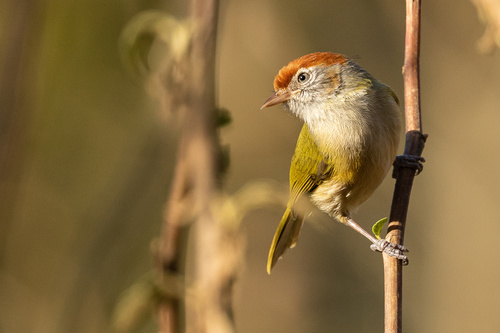
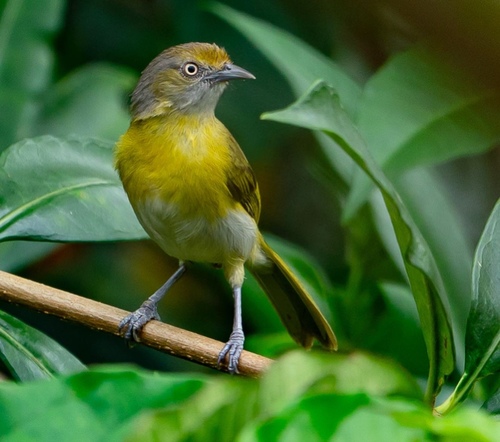
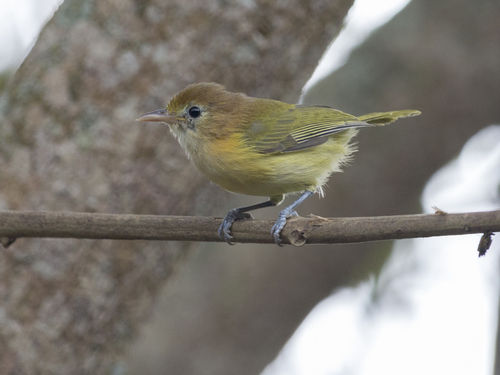
The golden-fronted greenlet (Hylophilus aurantiifrons Lawrence, 1861) measures 11 to 12 cm (4.3 to 4.7 in) in length and has an average weight of 9.5 g (0.34 oz). Males and females have identical plumage. Adult individuals of the nominate subspecies have an ochre-olive forehead and a buffy brown crown. Their upperparts are greenish brown, with a more yellowish green tone on the rump. The wing coverts are greenish brown, while the primaries and secondaries are dull blackish gray with thin greenish edges along their outer webs. Their tail is dull olive-green. The chin and throat are whitish buff, the breast is grayish yellow, and the belly and vent are yellowish. Subspecies P. a. saturata has more brightly colored underparts than the nominate subspecies, with a stronger buffy or ochraceous wash over the breast. Subspecies P. a. helvina has a dark reddish brown crown; compared to the nominate subspecies, its upper breast is darker, its flanks are greener, and its undertail coverts are darker yellow. All subspecies have a brown or black iris, a dusky horn-colored upper mandible, a pinkish lower mandible, and grayish brown or plumbeous legs and feet. The nominate subspecies of the golden-fronted greenlet ranges from Coclé Province in Panama east into northern Colombia. Subspecies P. a. helvina occurs in northwestern Venezuela, west of the Andes from Zulia east to southern Táchira and northern Mérida. Subspecies P. a. saturata is found on Trinidad and from eastern Colombia across most of northern Venezuela. This species lives in a variety of tropical zone landscapes, including deciduous forest, gallery forest, secondary forest, evergreen forest edges, dry scrublands, and gardens. In terms of elevation, it occurs from sea level up to 1,000 m (3,300 ft) in Colombia, and up to 1,900 m (6,200 ft) in Venezuela.