About Hylodesmum nudiflorum (L.) H.Ohashi & R.R.Mill
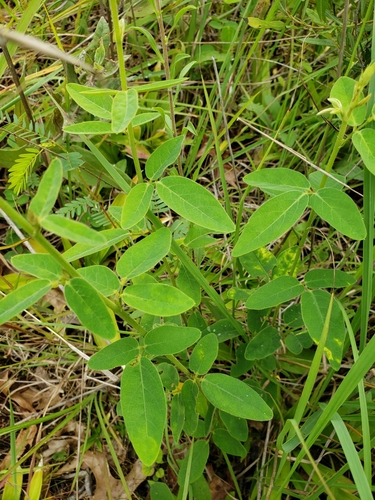
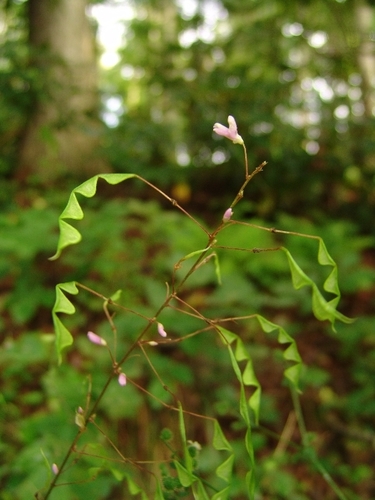
Hylodesmum nudiflorum, commonly called stemless tick trefoil, gets its common name from the fact that its flowering stem has no leaves. Leaves are held on a separate stem that grows up to around 50 cm (1.6 ft) tall. Its leaves are compound, with three distinct leaflets that measure 4–10 cm (1.6–3.9 in) long. Leaflets can be deltoid, oval, or ovate in shape, and leaves are arranged alternately on the stem. A leafless flower-bearing stem grows from near the base of the leaf-bearing stem, reaching about 3 ft tall. Flowers are 6–8 mm (0.2–0.3 in) long, range in color from pink to purple, and are arranged in either panicles or racemes. This species produces loment fruit, which can hold 1 to 4 seeds, most often 2 to 3 seeds. Each seed segment has hooked hairs that cling to clothing and fur when segments separate from the main fruit. An adult H. nudiflorum can produce up to 109 flowers, with a mean of 50 total flowers per plant. Around 22 percent of its flowers develop into fruit, and each fruit has an average of 2.8 seeds, according to Schaal and Smith 1980. This species has a taproot-led root system. Hylodesmum nudiflorum is distributed across the eastern United States, including the states of Alabama, Arkansas, Connecticut, Delaware, Florida, Georgia, Iowa, Illinois, Indiana, Kansas, Kentucky, Louisiana, Massachusetts, Maryland, Maine, Michigan, Minnesota, Missouri, Mississippi, North Carolina, New Hampshire, New Jersey, New York, Ohio, Oklahoma, Pennsylvania, Rhode Island, South Carolina, Tennessee, Texas, Virginia, Vermont, Wisconsin, West Virginia, plus the District of Columbia. It is also found in the Canadian provinces of Ontario and Quebec. Regarding conservation status, the species is listed as secure in Indiana, Kentucky, New York, North Carolina, Pennsylvania, South Carolina, Virginia, and West Virginia; it is apparently secure in Ontario, Delaware, New Jersey, and Vermont; vulnerable in Iowa; imperiled in Quebec and Minnesota; and critically imperiled in Kansas. Conservation status has not been determined for the rest of its range due to insufficient research. In less secure areas such as Minnesota, the species faces growing threats from habitat loss and invasive species. Most conservation efforts focus on protecting habitat, so no active management of populations is required. H. nudiflorum flowers produce a sweet fragrance that attracts bees and other nectar-feeding insects. Bumblebees are the main pollinators of the plant. Outcrossing is the predominant form of reproduction for this species, and it does not undergo asexual reproduction. Seed dispersal happens mainly when the hooked hairs on seed segments attach to the fur of mammals like deer. The plant's pollen grains are described as tricolporate and medium in size, measuring (28.1–)30.2(–33.1) µm along the polar axis and (25.0–)27.3(–29.7) µm along the equatorial diameter, with P/E = (1.02–)1.11(–1.21), prolate spheroidal or subprolate in overall shape, elliptic in equatorial view, and almost circular in polar view. H. nudiflorum is most commonly found in mature mesic oak forests, which are typically dominated by Northern red oak and basswood, and may also include white oak and black cherry trees. It is a perennial forest forb that occurs in low numbers and is restricted to specific colony areas within its habitat. It requires average amounts of water, and is typically found in partly shady locations with moist soil. It grows in circumneutral soil pH, and is tolerant to cold. Its flowers bloom in July and August, and its fruit develops from August to October.