About Hylocomium splendens (Hedw.) Schimp.
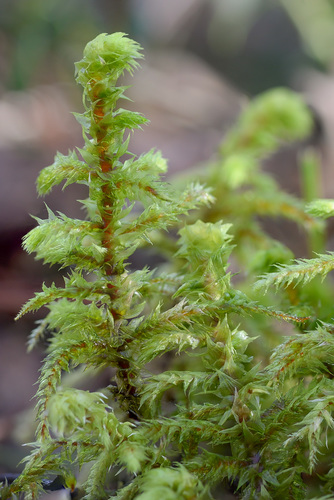
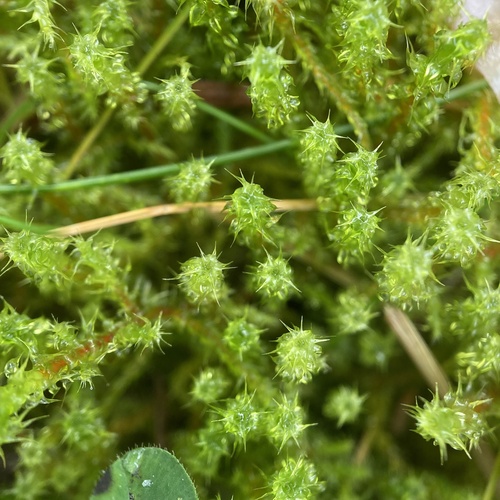
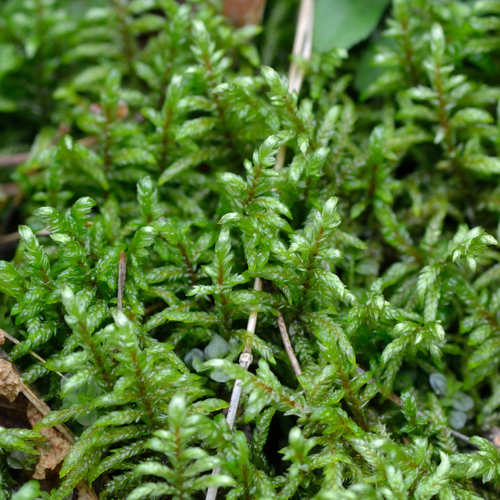
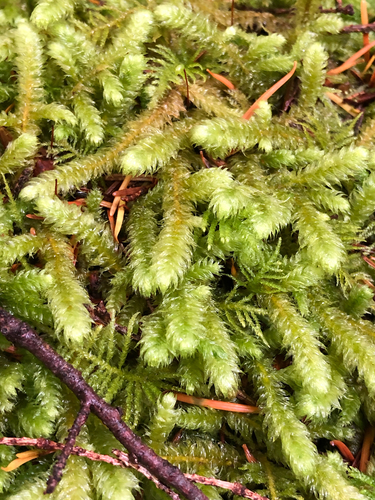
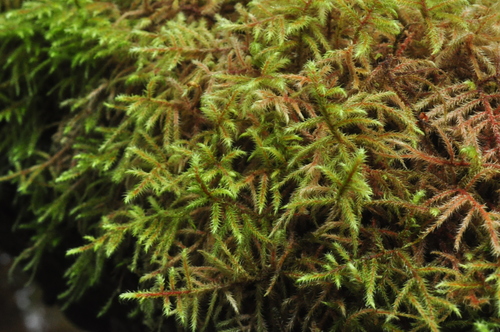
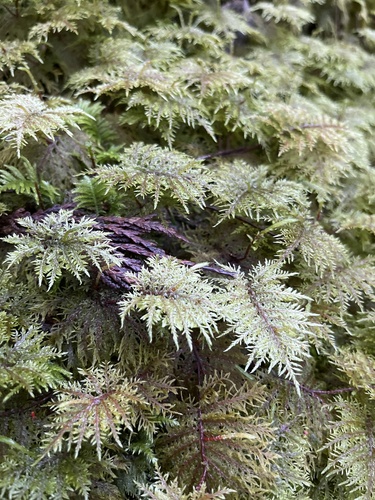
Hylocomium splendens (Hedw.) Schimp. is typically olive green, yellowish green, or reddish green, with reddish stems and branches. Branches often reach up to 20 cm in length, and each year’s new growth emerges from near the middle of the previous year’s branch. This annual growth pattern forms stepped, feathery fronds, and a plant’s age can be estimated by counting these steps, as one new step is produced each year. This growth form allows the species to climb over other mosses and fallen forest debris. It is a shade-loving species that grows on soil, humus, and decaying wood, and often forms mats where living tissue grows on top of older, dead or dying sections. Plants growing further south are larger and have more growth steps, while smaller plants with fewer steps occur further north in arctic tundra. This moss is widespread across boreal forests, and is commonly found on forest floors even at relatively harsh northern latitudes. For example, C. Michael Hogan notes that in Canada, the black spruce/feathermoss climax forest often has a moderately dense canopy, with a forest floor dominated by feathermosses including H. splendens, Pleurozium schreberi, and Ptilium crista-castrensis. Experiments simulating global change that test the effects of increased nutrient deposition and warming show that both increased nutrient deposits and climate warming can have negative impacts on the growth of Hylocomium splendens. Hylocomium splendens has commercial uses, including in floral displays and for lining fruit and vegetable storage boxes. Historically, it was used as a floor covering for dirt floors. In Alaska and northern Canada, it is still used today to pack gaps between logs in log cabins. It has documented antibacterial properties, and may contain anti-tumour agents. In Northern Europe, H. splendens is used for biogeochemical mapping: spectrometry techniques such as plasma-mass spectrometry allow researchers to test 38 elements to detect airborne heavy metal pollution.