About Hylochoerus meinertzhageni Thomas, 1904
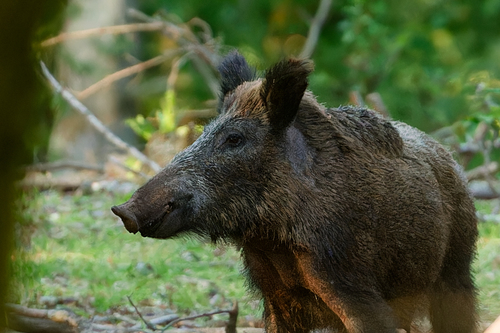
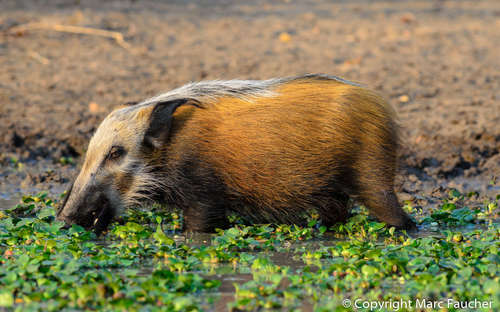
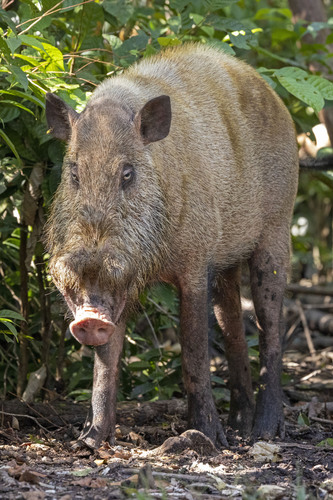
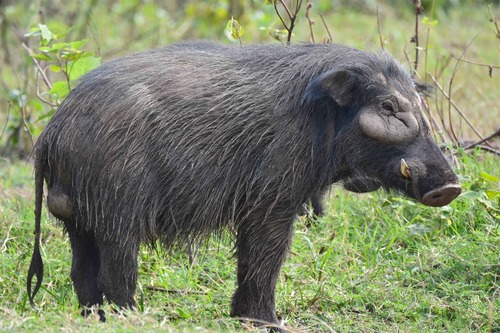
The giant forest hog (Hylochoerus meinertzhageni Thomas, 1904) is on average the largest living suid species. Adult head-and-body length ranges from 1.3 to 2.1 m (4 ft 3 in to 6 ft 11 in), and their tails add an extra 25 to 45 cm (9.8 to 17.7 in) of length. Adults stand 0.75 to 1.1 m (2 ft 6 in to 3 ft 7 in) tall at the shoulder, and weigh between 100 to 275 kg (220 to 606 lb). Females are smaller than males: the median weight of females is approximately 167 kg (368 lb), while the median weight of males is 210 kg (460 lb). Among its three recognized subspecies, the eastern nominate subspecies is slightly larger than H. m. rimator from Central Africa, and noticeably larger than H. m. ivoriensis from West Africa. The West African subspecies H. m. ivoriensis is sometimes scarcely larger than the related bushpig, with a maximum recorded weight of around 150 kg (330 lb). The giant forest hog has extensive body hairs, which become less prominent as the animal ages. Its outer coat is mostly black, while the hairs closest to the skin are a deep orange colour. It has large, pointy ears. Its tusks are proportionally smaller than the tusks of warthogs, but larger than those of bushpigs; the tusks of a mature male may reach 35.9 centimetres (14.1 in) in length. Giant forest hogs live in west and central Africa, where they are mostly restricted to the Guinean and Congolese forests. Small, localized populations also live in the humid highlands of the Rwenzori Mountains on the border between Uganda and the Democratic Republic of the Congo, and as far east as Mount Kenya and the Ethiopian Highlands. They occur primarily in forest-grassland mosaics, but can also be found in wooded savanna and subalpine habitats at altitudes up to 3,800 m (12,500 ft). They cannot tolerate low humidity or prolonged exposure to sunlight, so they are not found in arid regions or habitats that lack dense cover.