About Hylocharis sapphirina (J.F.Gmelin, 1788)
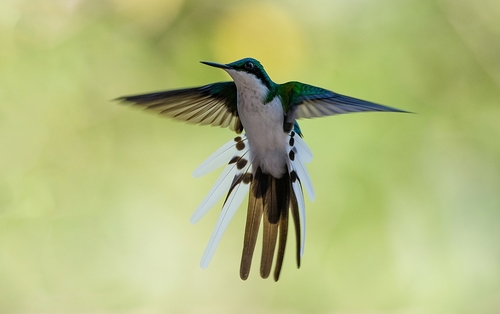
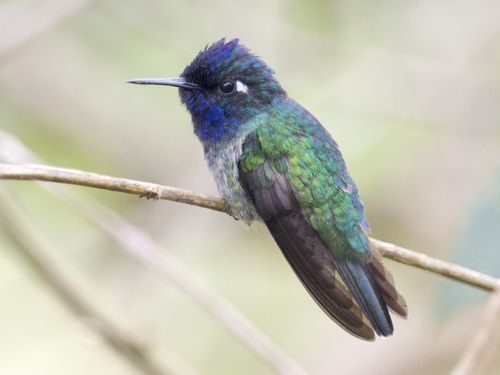
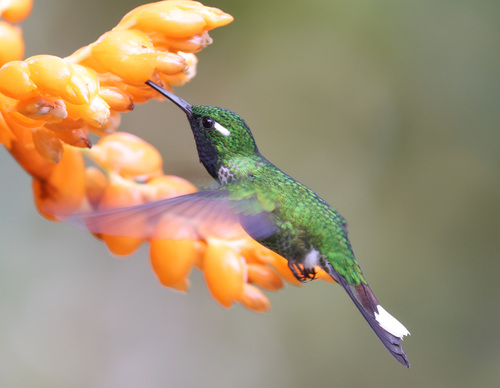
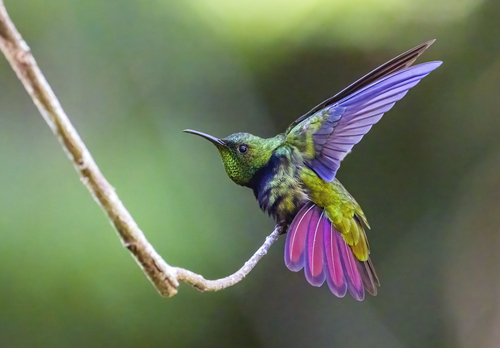
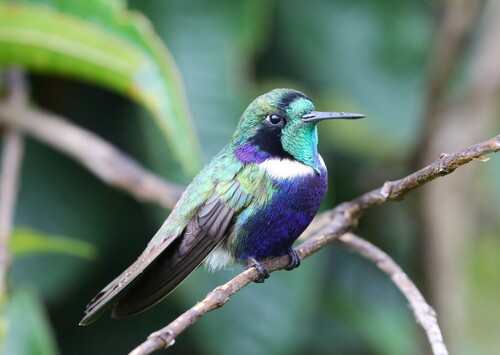
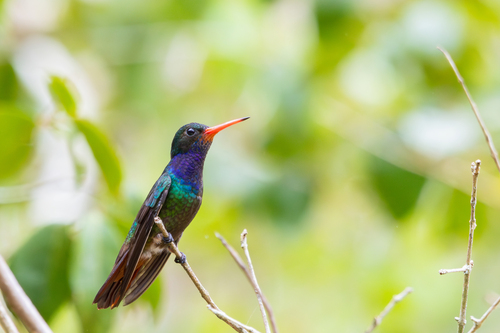
The rufous-throated sapphire, Hylocharis sapphirina, measures 8.4 to 9.1 cm (3.3 to 3.6 in) in length. Males weigh 4.1 to 4.5 g (0.14 to 0.16 oz), while females weigh 3.9 to 4.3 g (0.14 to 0.15 oz). Males have a medium-length, straight coral red bill with a black tip; females have less red on their bills. The species gets its common name from the intense rufous chin of males; females have a paler rufous chin. Adult males have dark green upperparts with coppery violet uppertail coverts. Their throat, chest, and belly are iridescent violet-blue, and their undertail coverts are chestnut. Their central pair of tail feathers are coppery with a violet tinge, and the other four pairs are chestnut with dusky gray tips. Adult females share the same dark green upperparts as males. Their underparts are grayish, with large glittering blue-green spots on the throat and chest, and buffy undertail coverts. Their tail matches the male's pattern, with paler edges on the outer feathers. Juveniles are similar to adult females, but juvenile males have richer rufous coloring on the chin. The rufous-throated sapphire has three distinct geographic ranges. The largest range extends from eastern Colombia east through Venezuela, the Guianas, and northern Brazil to the Atlantic coast; it also runs from southwest Colombia through eastern Ecuador into northern Peru, and spans a wide southwest band from northeastern Brazil into northeastern Bolivia. A second smaller range runs from Bahia state in southeastern Brazil south to northern Paraná. A third range includes southeastern Paraguay, northeastern Argentina, and adjacent southwestern Brazil, as recognized by the International Ornithological Committee and the Clements taxonomy. The South American Classification Committee of the American Ornithological Society lists this species as hypothetical in Paraguay and Argentina, because existing records have not been supported by photographs or other tangible evidence. This hummingbird inhabits semi-open to open landscapes, including lowland forest edges, savanna with scattered tree stands, clearings around rock outcrops, and coffee plantations. It rarely occurs in open coastal vegetation. It is most abundant at elevations between 200 and 500 m (660 and 1,600 ft), but has been found as high as 1,850 m (6,100 ft).