About Hylobates pileatus Gray, 1861
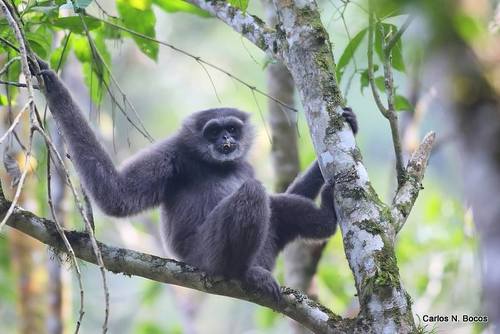
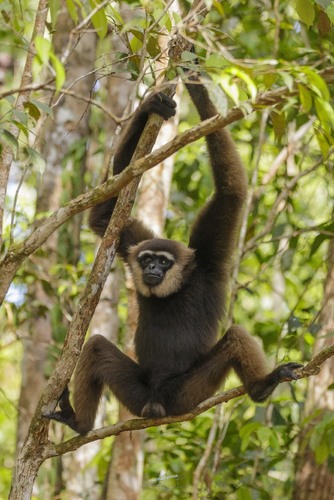
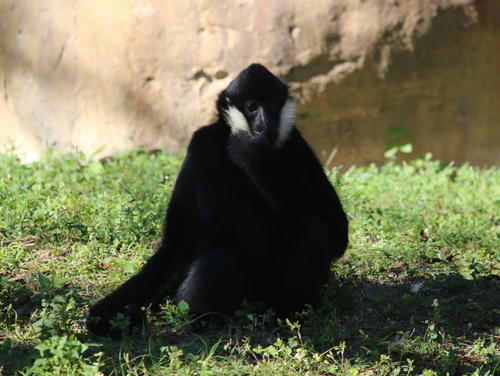
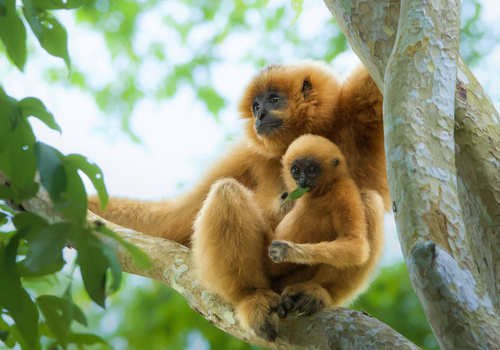
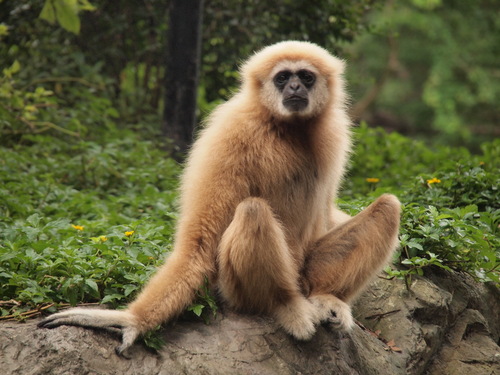
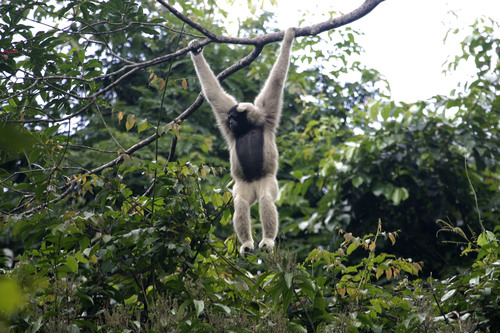
The pileated gibbon, scientifically named Hylobates pileatus Gray, 1861, is a primate that belongs to the gibbon family Hylobatidae. This species shows sexual dimorphism in its fur coloration: males have entirely black fur, while females have buff-colored or white-grey fur, with only their belly and head being black. A distinctive white, often shaggy ring of hair around the head is present in both males and females. The pileated gibbon is classified as endangered and is included in CITES Appendix I. Its primary threat is habitat destruction, as the natural forests it inhabits are converted to farmland. This habitat loss has caused the species to go locally extinct in some areas. Additionally, like many other primate species, pileated gibbons are hunted and captured for meat, and are trafficked through illegal wildlife smuggling. Multiple efforts have been made to survey the species and grow its population, both in wild habitats and in zoos. The pileated gibbon is native to eastern Thailand, western Cambodia, and southwest Laos. Its lifestyle matches that of other gibbons: it is diurnal and arboreal, lives in monogamous pairs, moves through tree canopies via brachiation using its long arms, and feeds mainly on fruits, leaves, and small animals. The reproductive habits of the pileated gibbon are not well studied, but they are assumed to be similar to those of other gibbons. Mating pairs jointly mark their own territory, and both the male and female produce loud vocalizations to signal this territory boundary. Confirmed populations of the pileated gibbon are recorded in multiple specific areas. There are approximately 35,000 individual pileated gibbons in Cambodia, and around 30,000 in Thailand. Specific locations holding populations include Khao Yai National Park, Thap Lan National Park, Khao Ang Ru Nai Sanctuary, Khao Soi Dao Sanctuary, Pang Sida National Park, and Ta Phraya National Park in Thailand; and the Cardamom Mountains (holding around 20,000 individuals) and Bokor National Park (holding around 1,000 individuals) in Cambodia.