About Hylobates moloch (Audebert, 1798)
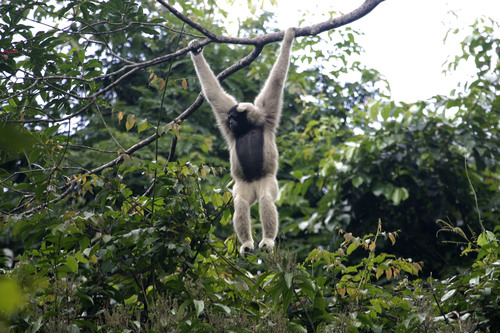
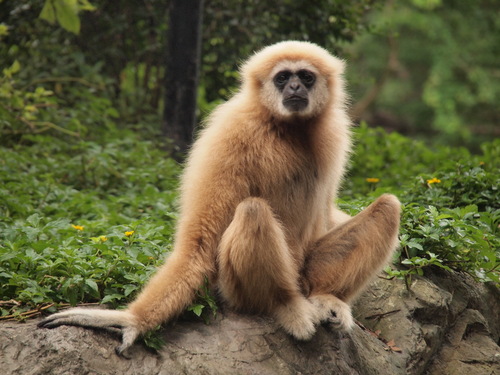
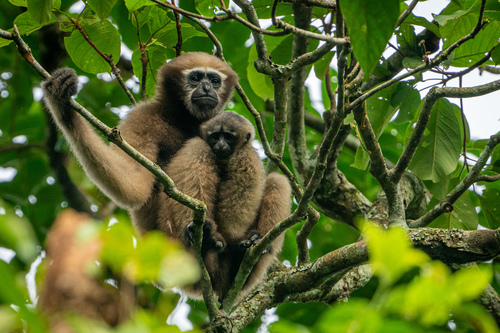
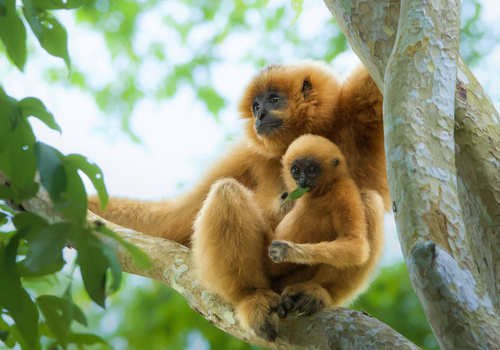
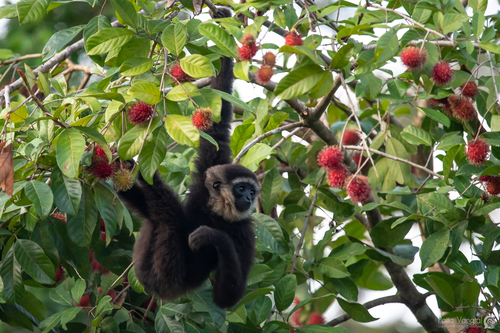
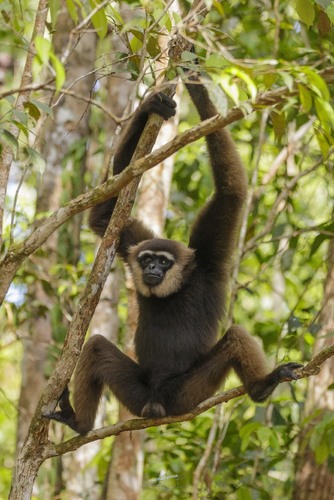
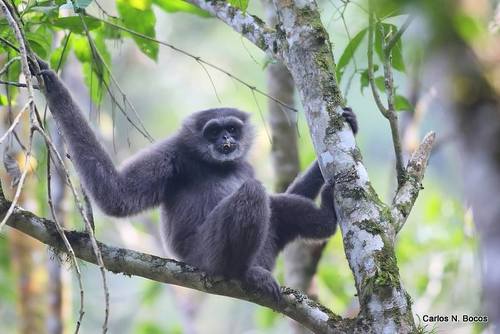
The silvery gibbon (Hylobates moloch), also called the Javan gibbon, is a primate belonging to the gibbon family Hylobatidae. It is endemic to the Indonesian island of Java, where it lives in undisturbed rainforests at altitudes up to 2,450 m (8,040 ft). It has been classified as Endangered on the IUCN Red List since 2008, with the estimated wild population containing fewer than 2,500 mature individuals. Its fur is bluish-grey, with a dark grey or black cap on its head. Like all gibbons, the silvery gibbon has no external tail, scapulae positioned on the dorsal side, and reduced flexibility in the lumbar region. It has long, curved fingers and forelimbs that are very long relative to its hind limbs. On average, adult silvery gibbons weigh 8 kg (18 lb). The silvery gibbon is diurnal and arboreal, climbing trees skillfully and moving through forests via brachiation. This movement is enabled by its mobile wrist joints, full rotation of the upper arm, and the ability to lock elbows when suspended. Its diet is made up of fruits, leaves, and flowers. On average, females give birth to a single young every three years, after a seven-month gestation period. Offspring are nursed for around 18 months, and stay with their family group until they reach full maturity at 8 to 10 years old. Like all gibbon species, the silvery gibbon lives in pairs and marks out a territory that the pair defends vigorously. Their territories are relatively small, covering around 42 acres (17 hectares). Females sing to mark their territory several times a day, and if strangers are detected, males scream to scare the intruders away. Most solo song bouts and scream bouts are produced by females. Female vocal bouts happen after 05:00, with peak vocal activity around 06:00. In contrast, male vocal bouts, which mostly occur before 05:00, are structured as choruses with a minimum of three participants. These choruses occur roughly every 8.5 days. They start earlier and last longer than female solo song bouts. Most male songs begin while it is still dark, between 03:55 and 04:40. Males are typically very aggressive towards other gibbons outside their pair.