About Hylia prasina (Cassin, 1855)
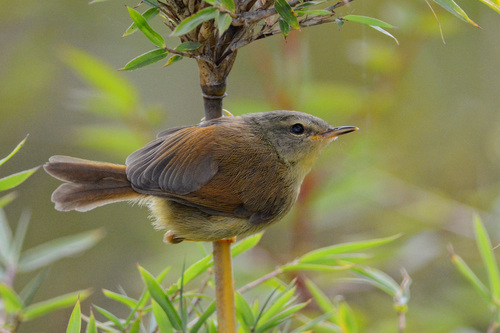
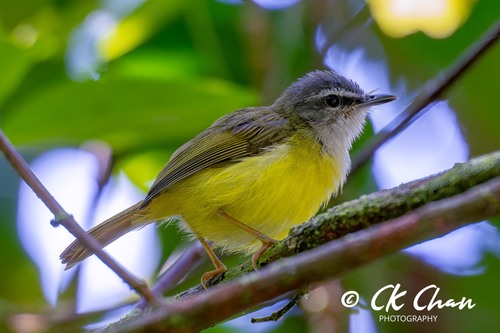
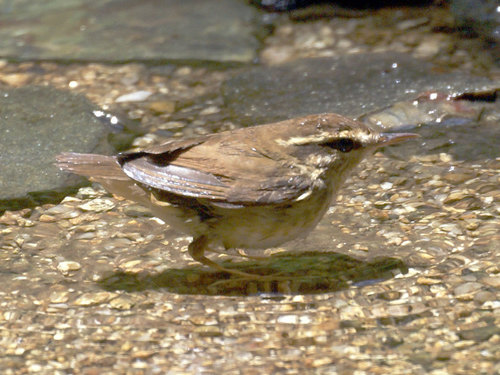
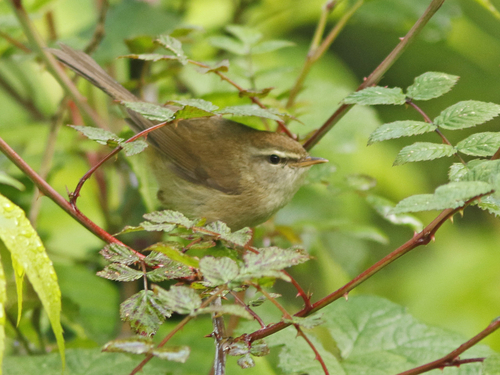
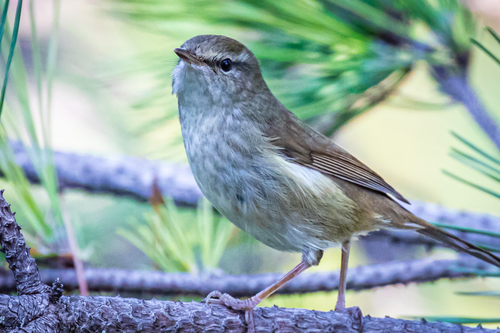
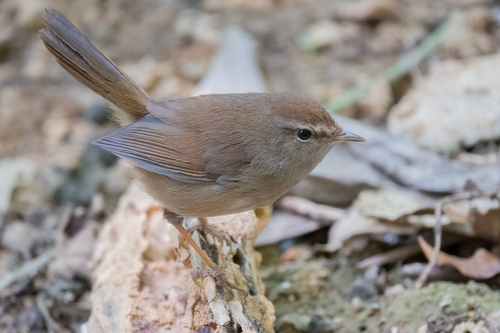
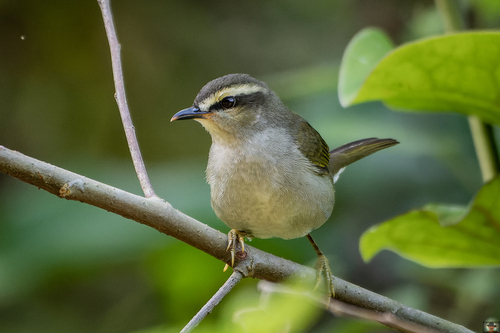
The green hylia (Hylia prasina) has dark brown irises, a black bill, and olive green feet. Individuals of this small species weigh approximately 14 grams. There is no noticeable color difference between the sexes, though males are generally larger. This species has two subspecies: H. p. prasina and H. p. poensis, which differ in the coloration of the underparts below the throat. H. p. prasina has an olive green chin and throat, and an olive-grey underbelly, while H. p. poensis has a white-grey throat and underbelly. Green hylia range across most of tropical Africa in a wide distribution. The subspecies H. p. poensis is found only on islands in the Gulf of Guinea. H. p. prasina has a much wider distribution throughout the Guineo-Congolian forest, occurring from western Gambia to western Kenya. The green hylia is a common forest generalist that occurs in forest edges, vegetation gaps, and forest interiors. Its preferred habitat is mostly intact, semideciduous moist forest. Plant species found in green hylia habitat include Elaeis guinensis, Celtis zenkeri, Cola gigantea, Acalypha ornata, Markhamia platycalyx, Coffea canephora, Albizia sp., Fagara macrophylla, Funtumia elastica, Pycnanthes angolensis, Musanga cecropioides, and Xylopia aethiopica. Tangled lianas and Scleria species form suitable habitat, and also provide the green hylia with nesting materials and a food supply. Analysis of carbon sources in the insects consumed by green hylia shows that all carbon in their food comes exclusively from C3 plants, which are mostly forest plants, rather than C4 plants common in farmland crops, even when farmland borders forest habitats. The green hylia is a foliage-gleaning insectivore that forages in the canopy and forest understory, typically at heights around 10 metres. Its diet consists of insects including ants and butterflies found in its feeding area, on the undersides of leaves, or in forest litter. The species is classified as a forest generalist because it can survive in a broad range of environmental conditions. Green hylia are usually observed alone or as mated pairs. Mated pairs roost together in their nest. The eggs are white and have no other distinctive markings. Nests are built a few feet from the ground in suitable locations, such as the vertical forks of young palm trees. Nests are oval and domed, with a 20 mm circular opening on the side near the top. The bulk of the nest is made of unfragmented, loose tufts of plant material that are not interwoven or compacted, giving nests a crumbly, friable texture. The outside of the nest is covered by a fine layer of fibrous strips, with occasional leaf skeletons placed on top. Nests measure 150 mm from top to bottom, and 90 mm across both side-to-side and front-to-back dimensions. Unlike the nests of other sunbirds, green hylia nests are positioned in vegetation forks rather than being suspended in air.