About Hylesia nigricans Berg, 1875
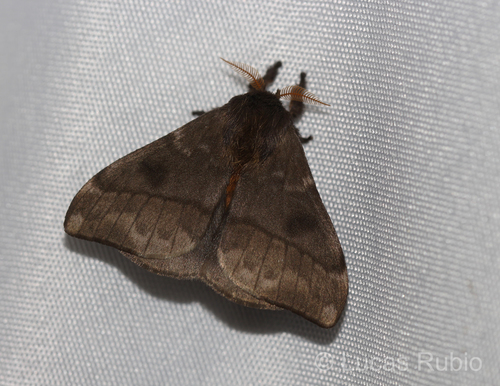
Hylesia nigricans is a species of moth in the Lepidoptera family Saturniidae. This nocturnal moth is endemic to Argentina and Brazil, and is mainly found in northern and central Argentina, southern Bolivia, and southern Brazil, as climate conditions in these areas favor its reproduction. The species was first formally described by Carlos Berg in 1875. Adult females reach an average wingspan of 45 millimeters. The larvae have an average length of 40 to 45 millimeters, with black and yellow bodies covered in urticating hairs. Contact between these hairs and human skin causes irritation that leads to prolonged dermatitis. In Spanish, the larvae are called gata peluda, meaning hairy cat, or bicho quemador, meaning burning bug. The adult moth is dark-colored, which is the source of its species name, and the back of its abdomen is covered in smooth golden hairs. Hylesia nigricans has a voracious appetite, and attacks fruit-bearing, ornamental, and forest plants. It was declared a national plague in Argentina in 1911, and a number of chemical products are used to control its population growth. For its life cycle, females lay eggs in overlapping clusters of up to 900 eggs. The egg cluster is protected by a yellow covering that the female builds using her own secretions and abdominal hairs. Between 200 and 740 eggs hatch during spring, which occurs from October to December in the region. After hatching, larvae move in large groups along tree trunks, branches, and leaves, and usually cause extensive defoliation. Before pupation, a larva collects leaves and binds them together with its bodily secretions to make a cocoon, which is located either on a plant or among leaf litter on the ground. The insect stays immobile in its pupal stage throughout the winter.