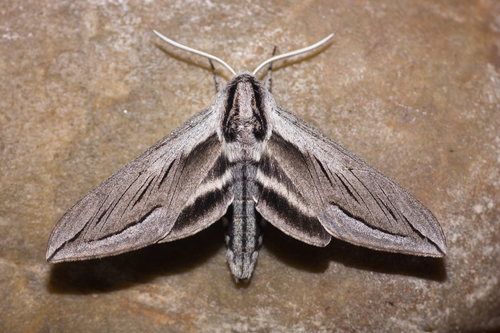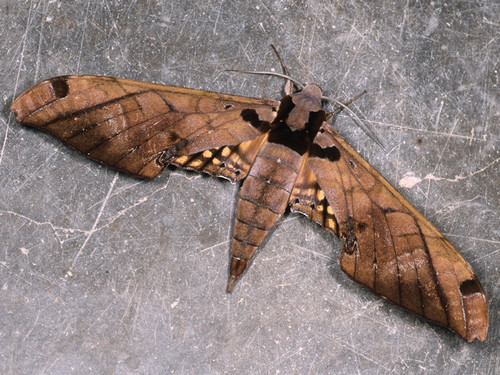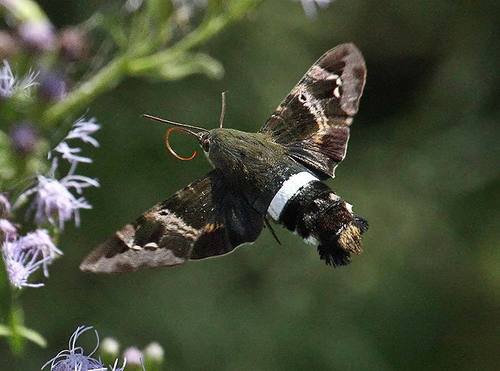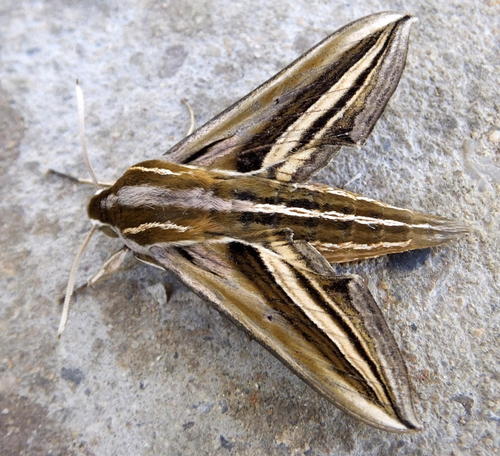
About Hyles lineata Fabricius, 1775
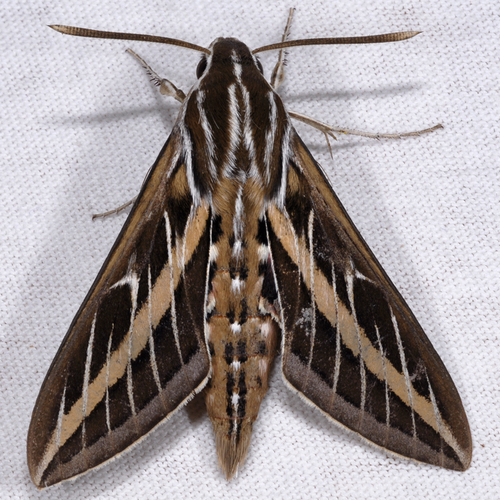
Hyles lineata, commonly called the white-lined sphinx, is a moth species in the family Sphingidae. It is sometimes referred to as a "hummingbird moth" due to its bird-like 2–3 inch wingspan and flight patterns. While H. lineata caterpillars display a wide variety of color phenotypes, adult moths have consistent coloration. This moth has a broad geographic distribution across Central and North America; as caterpillars it feeds on many different host plants, and as adults it pollinates a wide range of flowers. H. lineata larvae are voracious feeders that often form large groups capable of damaging crops and gardens. Adult moths use both visual and olfactory senses to locate plants to collect nectar from. Hyles lineata is one of the most abundant hawk moths in North America, with a very wide geographic range extending from Central America through Mexico and most of the United States to southern Canada. Habitats for this moth have also been reported in South Asian regions such as Sindh, Pakistan. It can occasionally be found in the West Indies, and rare specimens have been recorded in Eurasia and Africa. The population abundance of H. lineata in specific locations varies substantially from year to year, and this variation was thought to influence selection on flower phenotypes, though studies over the years have produced mixed results. Due to its extensive geographic range, H. lineata occupies a diverse array of habitats, including deserts, gardens and suburbs. It has also been found in large numbers in the mountains of Colorado, but its presence in many locations changes from year to year. Hyles lineata is a common pollinator that collects nectar from flowers. Caterpillars feed on a very wide diversity of host plants, while adult moths prefer nectar over other plant resources. A 1970s study investigated H. lineata nectar feeding behavior at Emerald Lake, Colorado, specifically focusing on visits to Aquilegia coerulea flowers. Among the H. lineata individuals that visited A. coerulea, two distinct groups were observed: one group had pollen patches near their eyes, while the other had no detectable pollen on their bodies. Tongue length differed significantly between the two groups: longer-tongued individuals carried no pollen, while shorter-tongued individuals carried pollen. These findings indicate that only some H. lineata individuals act as effective pollinators, with shorter-tongued individuals providing the most effective pollination. Other studies have explored how this moth influences the evolution of flower morphology. Hyles lineata individuals visiting Aquilegia chrysantha flowers in Pima County, Arizona had proboscis (tongue) lengths that closely matched the length of the flower's nectar spur, a pattern that suggests coevolution between the moth and the flower. All hawk moths, including H. lineata, are classified as long-tongued nectar foragers, but nearly 20% of all hawk moth species have much shorter tongues than H. lineata. A 1997 study found a correlation between moth tongue length and latitude distribution: mean tongue length decreases from around 40 mm to as short as 15 mm as latitude increases from 0 to 50 degrees north. The study author hypothesizes that hawk moth tongues have lengthened in extratropical regions, where larval food plants are often inconspicuous and harder to find energetically. Longer tongues allow moths to collect more nectar in one visit to fuel longer flights in search of food. In contrast, shorter tongues are sufficient in more northern regions because finding larval food plants is easier, and moths do not need to collect as much nectar to power their flights. A 2009 study found that whiter flowers are associated with the annual presence of hawk moths including H. lineata. The study's data also shows that annual presence of H. lineata populations creates selective pressure for whiter flowers. Another hawk moth species with overlapping range, Sphinx vashti, shows a correlation between annual presence and longer nectar spurs on flowers. Overall, hawk moths have been shown to affect selective pressure on flower morphology. Native Americans have historically gathered and eaten H. lineata caterpillars, and this practice continues in some areas today. After collection, caterpillars were skewered and roasted for feasts, and any leftovers were stored whole or ground after drying. Nutritional analysis of H. lineata larvae found they have significant nutritional value: they contain roughly as much fat as hamburger meat, but have around one-third less saturated fat. They also contain more energy (in calories), more protein, more carbohydrates, more riboflavin, and more niacin than hamburger meat.