About Hyles gallii von Rottemburg, 1775
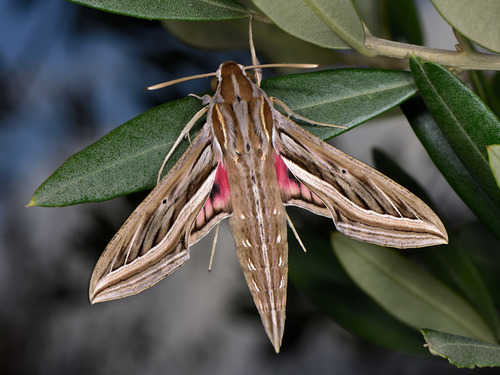
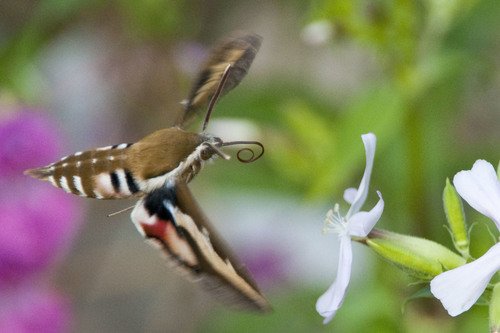
Hyles gallii (von Rottemburg, 1775) has a wingspan of 55 to 80 mm. This species is very similar in appearance to Hyles euphorbiae, but differs in two key traits: the red colouring on its hindwings is less extensive, and the olive-coloured band on its forewings is uninterrupted. The description below is taken from Edward Newman’s 1869 public-domain work The Illustrated Natural History of British Moths. Also called the Bedstraw Hawk-Moth, this moth has olive brown fore wings with a broad, irregular whitish stripe along the centre. Its hind wings are black at the base, followed by a broad pinkish-white band that is pure white near the body and bright pink in the middle, a distinct black band, and finally a grey margin. The thorax and body are olive-brown, with a white line on each side of the thorax right at the base of the wings; this line continues along each side of the head just above the eye. The sides of the body bear black and whitish spots. The smooth caterpillar is bluish-green on the upper side, with a pinkish tone on the underside; it may also be brown or sometimes black, but always has a pale, nearly yellow line down the middle of its back, plus a row of ten prominent eye-like yellow spots on each side. The caterpillar’s head matches its body colour, being green, brown, or black, but the horn above its tail is always red. The chrysalis is brown and is found in sand. Caterpillars feed during August and September, and adult moths emerge around Midsummer. Hyles gallii is distributed across North America, Europe as far north as the Arctic Circle, Central Asia, and Japan. It prefers sandy or calcareous sites, sunny heath, plantations, and warm forest edges, occurring anywhere that its host plants grow. In the Alps, these moths can be found at elevations up to 2700 meters above sea level.