About Hyleoides concinna (Fabricius, 1775)
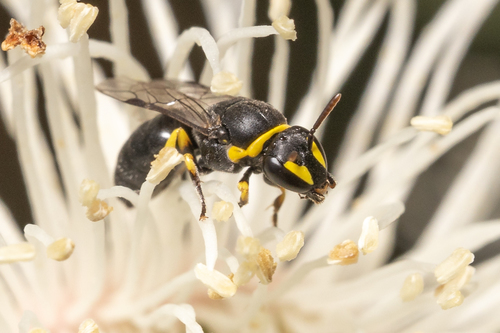
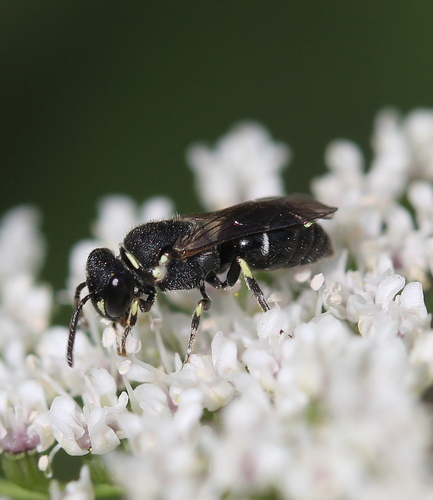
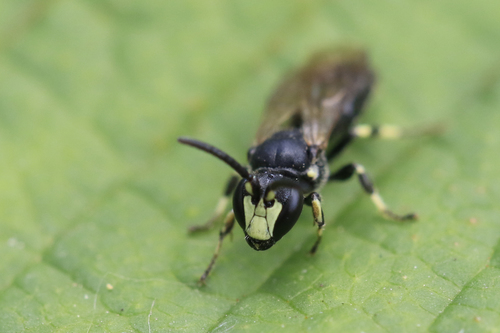
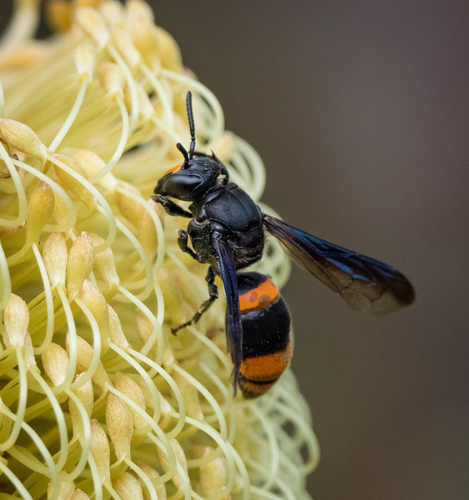
Hyleoides concinna, commonly known as the common wasp-mimic bee, has evolved multiple traits that allow it to resemble a potter wasp. These traits include a bold colour pattern, partially darkened forewings, and the habit of holding its wings in a V-shape when it lands. Because wasps are typically more aggressive than bees, this mimicry is thought to frighten off potential predators. This bee can be told apart from the potter wasps it mimics by small tufts of branched hairs on its thorax and its longitudinally-folded wings. The second abdominal segment of this bee is black, and the top of all remaining abdominal segments is mostly orange. A yellow band is located under the third abdominal segment. The thorax is black, and sometimes it has orange spots. The head is always black. Males and females can be distinguished by the shape and colour of markings on the clypeus: male markings are yellow, while female markings are orange and narrow toward the bottom. Males measure 10 to 12 mm (0.39 to 0.47 in) in length. Females are usually slightly larger, measuring 12 to 13 mm (0.47 to 0.51 in) in length.
The common wasp-mimic bee inhabits urban areas, woodlands, forests, and heath. It is native to south-eastern Australia, with confirmed records from South Australia (including Kangaroo Island), Victoria, Tasmania, the Australian Capital Territory, New South Wales, and southern Queensland. It was accidentally introduced to the North Island of New Zealand at some point before 1980. It is thought to have entered New Zealand as diapausing prepupae inside nests in imported timber, most likely entering through the ports of Gisborne and Napier. By 2021, the species had spread to the South Island of New Zealand, and it is expected to continue spreading to the rest of the country, which has a suitable climate for the bee.
The common wasp-mimic bee is a solitary species that produces one brood per year. In summer, females build nests in pre-existing cavities, such as tunnels that longhorn beetle larvae have previously made in wood. This bee will also nest in human-made cavities, including drilled holes in timber and bamboo canes placed in bee hotels. It prefers cavities with a diameter of 6 to 8 millimetres. To start nesting, females build a curtain of silk threads over the cavity entrance. These threads are formed from a cellophane-like material secreted by the bee. The threads are attached to the cavity walls but remain free in the centre, which lets the female move through easily. This entrance curtain is likely a visual deterrent to parasitoid insects. Females can often be observed resting behind the curtain, with only their antennae protruding through. After finishing the curtain, the female creates a series of brood cells using more of the waterproof cellophane-like material. Each cell is half-filled with a provision of nectar and pollen, and the female lays one egg on each provision. Females of this species carry pollen internally, because they lack the external pollen-carrying structures found in many other bee species. Up to eight cells may be provisioned and closed before the female seals the entire nest with a solid wall to protect it from predators. Larvae consume the stored provisions, pupate, and emerge as adult bees the following spring. In Australia, adult bees can be observed from October to March, based on records from the Sydney region. In New Zealand, adults are most active from November to March. The common wasp-mimic bee has been recorded visiting flowers from a wide range of genera, including Angophora, Callistemon, Eucalyptus, Lophostemon, Banksia, Daviesia, Jacksonia, Melaleuca, Brachychiton, Eremophila, Lambertia, Persoonia, Pultenaea, Leucospermum, Saponaria, Chrysanthemum, Tecoma, Bursaria, Foeniculum, and Acmena. It tends to forage on flowers more slowly than honeybees and wasps, a trait that helps distinguish it while it is in flight. Males are known to form roosting groups on branches or twigs. Females are capable of stinging, but they are not aggressive, and will only sting humans if pressed against the skin.