About Hylamorpha elegans (Burmeister, 1844)
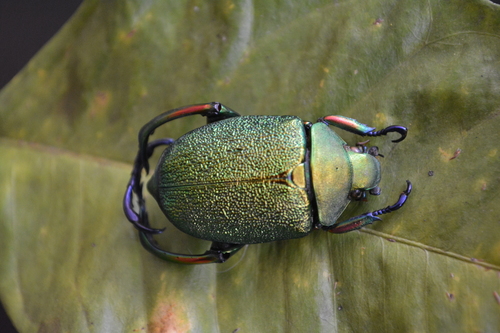
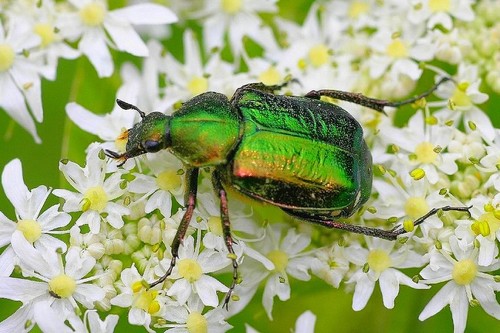
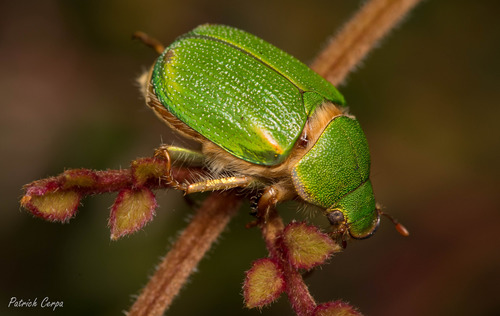
Hylamorpha elegans (Burmeister, 1844) has an elongated body that typically measures 11.8 to 18.2 millimetres (0.46 to 0.72 in) long, and 5.8 to 10.8 millimetres (0.23 to 0.43 in) wide across the shoulders, giving it a distinct appearance. Its head, pronotum, and elytra (wing covers) range in color from light to dark green, sometimes with shiny silver or bronze reflections, and are rarely orange. Preservation chemicals used on collected specimens can turn the elytra blue, red, orange, or purple. There are consistent differences in leg coloration and texture between male and female individuals. Males have entirely green, shiny legs, with the most noticeable shine on the middle and back legs. Females have green legs that show varying degrees of shine; their front legs are mostly light brown, while their back legs are green, matching the body color. The tips of the beetle's protibial teeth are always black. The head is densely covered with small punctures (bumps or dots). Antennae have ten segments total, and the final segment is longer in males than in females. Mandibles are triangular, ending in either a sharp or a rounded point. The dorsal surface (back) has tiny punctures, and the lateral sides bear a small ridge. Long white hairs grow on the hind legs and the underside of the body. The front legs have three small teeth at their distal end, and the back legs have a tubercle (bump) on the outer edge. The ventral side of the legs has small punctures, and the ultimate abdominal segment is slightly curved in both males and females. Like other scarab beetles, H. elegans likely uses thermo- and hygrosensitive sensilla to evaluate its environment. Four types of sensilla are found on the species' antennae: sensilla chaetica, which are likely mechanoreceptors; sensilla trichoidea; sensilla placodea; and sensilla coeloconica, which may detect humidity and temperature. Adult beetles usually emerge from the ground in spring and summer, when evening temperatures are warmer. This species inhabits both sides of the Andes in central and southern Chile and southwestern Argentina. Its range matches the distribution of Nothofagus species, which serve as a food source for adult beetles. Hylamorpha elegans has a broad diet that includes various plant parts, and it is considered a significant agricultural pest. In the larval stage, the beetle feeds primarily on the roots of grasses and small grain cereals, causing severe agricultural damage in Chile. Adult beetles feed on Nothofagus species, mainly N. antarctica, N. betuloides, N. dombeyi and N. obliqua. They will occasionally defoliate their host trees, and large populations feeding on young trees can kill the trees.