About Hylaeus relegatus (Smith, 1876)
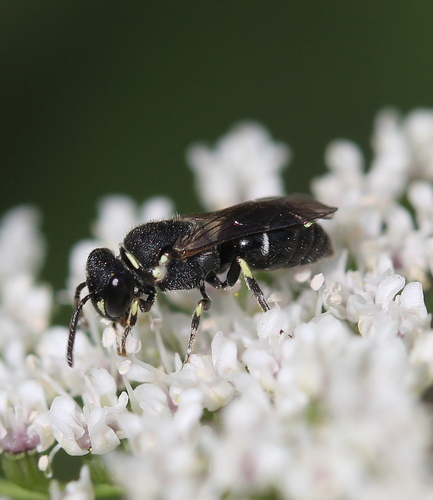
Smith originally gave the following description for male Hylaeus relegatus. The male has a body length of 3 and a half lines. It is black, with a subopaque head that is very closely and finely punctured. Its clypeus and inner orbits of the eyes, extending as high as opposite the point where the antennae insert, are yellowish-white. Its mandibles bear a longitudinal white stripe. On the thorax, the disk is closely and finely punctured. The metathorax has a triangular enclosed space at its base, which carries a series of abbreviated striae along its basal margin. A spot on each side of the collar, and the tubercles, are yellow. The wings are subhyaline, iridescent, with black nervures. The first recurrent nervure connects with the first transverso-medial nervure, and the second recurrent nervure is received near the apex of the second submarginal cell. The calcaria are pale testaceous. The abdomen is oblong-ovate and shining, and is very finely punctured towards its base.
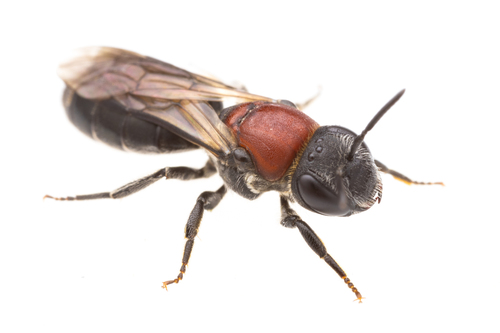
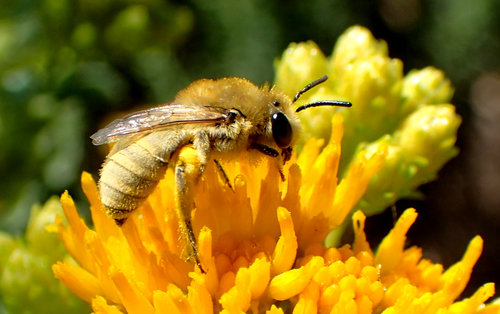
Females of this species have a body length between 6.5 and 9.1 mm. They are black, with yellow markings on the facial area that extends along the sides of the face parallel to the eye. Female facial colouration is variable, and females found on the Three Kings Islands lack these yellow markings entirely. Males of the species have a body length between 5.7 and 7.7 mm, and their face is entirely yellow except for a black lower margin.
This species is endemic to New Zealand, and can be found on the North, South, Stewart, Chatham and Three Kings Islands. While it is spread across the whole country, it is not normally abundant in any single location.