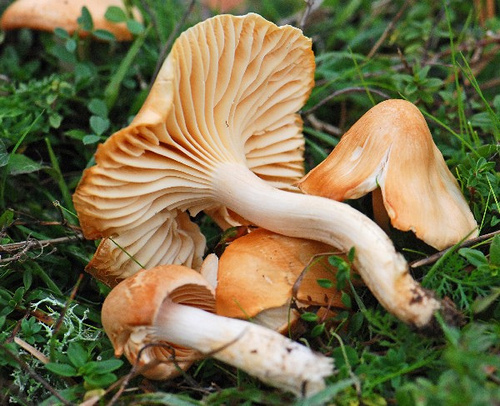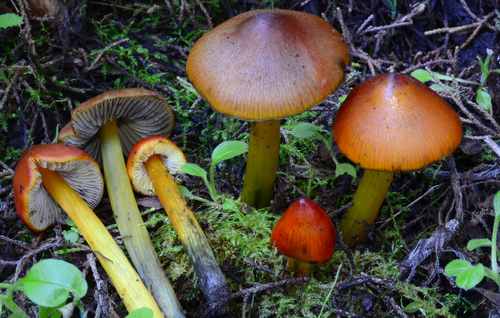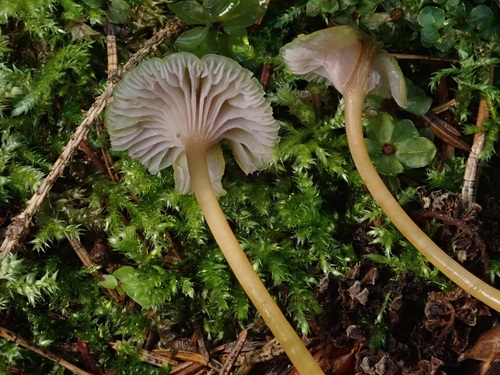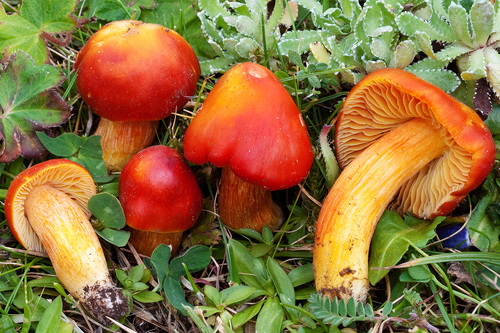
About Hygrophorus erubescens (Fr.) Fr.
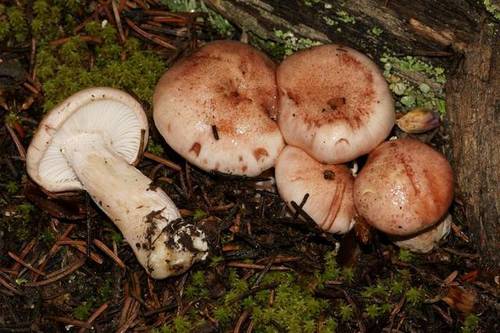
The fruit body (mushroom) of Hygrophorus erubescens is moderately sized, with a cap measuring 4–8 cm (1+5⁄8–3+1⁄8 inches) in diameter. The cap ranges in color from light pink to white, may be dotted with darker pink or red marks, and bruises yellow. Its color is darker at the cap center. Young caps are convex with an inrolled margin and often a raised central boss, and they flatten as the mushroom ages. The cap surface is slimy or sticky. The gills start white, are adnate to somewhat decurrent, and turn pale pink as they mature. The stipe measures 5–8 cm (2–3+1⁄8 inches) in height and 0.8–1.5 cm (3⁄8–5⁄8 inches) in width. The spore print of this species is white, and its oval spores measure 6.5–11 by 4.5–6.5 micrometres. The mushroom has no strong odor or taste, though its odor is sometimes described as pleasant. This species is inedible.
Hygrophorus erubescens fruits from August to October in coniferous forests, particularly spruce stands, growing on chalky soils. Mushrooms occur either singly or sometimes in large troops. In North America, its range extends from the Rocky Mountains to the West Coast and Tennessee, north to the Great Lakes region and southern parts of Canada. On the British Mycological Society's 2006 list of threatened fungi, this fungus is classified as extinct, as it has not been recorded in Great Britain since 1878. It can be found across Scandinavia, has been recorded fruiting at high altitudes in the alpine-subalpine regions of Russia, and occurs in mountainous parts of Central Europe. It has also been found in the East and Middle Black Sea regions of Turkey. In Japan, it is most common in coniferous woods, and has been recorded from Hokkaido and Honshu.