About Hygrophorus bakerensis A.H.Sm. & Hesler
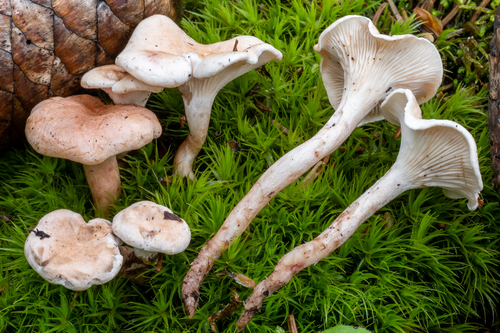
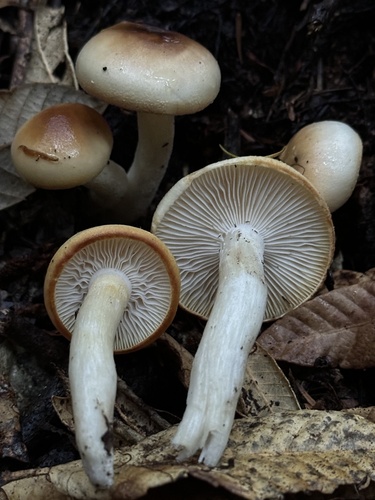
Description: Young fruit bodies of Hygrophorus bakerensis have rounded caps with cottony, inward-rolled margins. As the mushrooms mature, caps flatten, and margins may lift upward. Cap diameter ranges from 4 to 15 cm (1+1⁄2 to 6 inches). The cap center is yellow-brown, tawny, or amber, fading to nearly white at the margin. When wet, the cap surface is slimy; it becomes sticky as it ages and dries. Under the slime layer, hairs lie tightly plastered to the surface, and clump in small groups to form many fine streaks. The cap's firm white flesh is thick, measuring 1 cm (1⁄2 inch) near stem attachment, and tapers evenly toward the margin. The flesh does not change color when cut or bruised. It has a mild taste and a characteristic fragrant odor similar to almonds or crushed peach pits. The waxy gills are either decurrent (running down the stem) or bluntly attached to the stem. Gill spacing ranges from close to subdistant: 56 to 88 full gills reach the stem, with 2 to 3 tiers of shorter partial gills (lamellulae) that do not extend all the way from the cap margin to the stem. Gills have even edges, are narrow but widen to 8–12 mm in large caps, and range in color from creamy white to pinkish-buff. They do not discolor when bruised. Young specimens often have droplets of clear liquid beaded on the gills; gills of dried specimens darken considerably. The stem measures 7 to 14 cm (2+3⁄4 to 5+1⁄2 in) long, and 0.8 to 2.5 cm (1⁄4 to 1 in) thick at the apex. It is solid (not hollow), and is either equal in width along its length or narrows downward. Stem color ranges from white to pale pinkish-buff, with a dry surface. Young specimens have a fine, cottony whitish powder near the top of the stem, which sloughs off as the mushroom matures. Like the gills, the top of the stem is often beaded with drops of translucent liquid in moist weather. The spores are ellipsoid, smooth, and measure 7–9 by 4.5–5 μm. They stain yellowish when treated with Melzer's reagent. The four-spored spore-bearing basidia in the hymenium measure 40–54 by 6–8 μm. No cystidia are present on gill faces or edges. The cap cuticle is an ixotrichoderm: a layer of gelatinized tissue where the distal ends of filamentous hyphae vary in length, and hyphae are arranged perpendicular to the cap surface. This layer of gelatinous hyphae is 100 to 250 μm thick. Clamp connections are present in the hyphae of both the cap cuticle and gill tissue. Habitat and distribution: Hygrophorus bakerensis is an ectomycorrhizal species that forms a mutualistic relationship with compatible host plants by growing a sheath around the plant's root tips. Through this association, the fungus gains carbon and other essential organic compounds from the host tree, and in return helps the tree absorb water, mineral salts, and metabolites. The association also helps the tree fight off parasites and predators including nematodes and soil pathogens. Known associated tree species include Douglas-fir. Fruit bodies grow scattered, clustered, or in groups on conifer forest floors. It is common at elevations between 1,000 and 4,000 ft (300 to 1,220 m) across the Pacific Northwest region of the United States and the northern Rocky Mountains. It has been collected in California, Idaho, Washington, and Oregon. It has been recorded as far north as Hazelton, British Columbia, and as far east as Quebec, Canada. Fruit bodies typically appear from September to December, and can be very abundant.