About Hygrophorus agathosmus (Fr.) Fr.
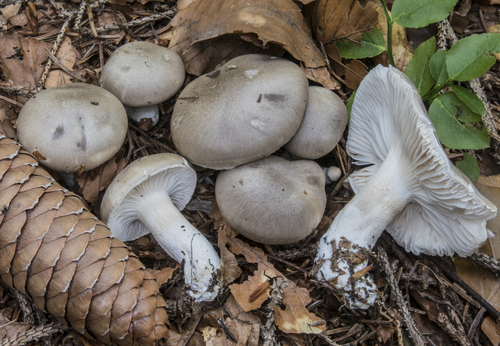
Hygrophorus agathosmus (Fr.) Fr. has a cap 3–10 cm (1.2–3.9 in) in diameter that is initially convex with inward rolled edges. As it matures and expands, the cap becomes flat, sometimes with a slightly depressed center, or sometimes a slight central elevation. The cap is dull ashy gray; when moist, its surface is sticky or tacky to the touch. It is overall smooth, though the cap edges may have a layer of minute, soft hairs. The flesh is soft, and ranges in color from whitish to watery gray. This species has a pronounced fragrant odor that resembles cherry pits or bitter almonds, though the odor is occasionally weak. The gills have an adnate attachment to the stem, but the attachment becomes adnate-decurrent when the mushroom reaches maturity, meaning the gills begin to extend down the length of the stem. Gills are white when young, turning grayish at maturity; between 40 and 50 gills reach the stem, spacing ranges from close to distant, and gills are moderately narrow and rather thin. The stem is 4–15 cm (1.6–5.9 in) long and 0.6–2 cm (0.2–0.8 in) thick. It is whitish when young, becoming pale ashy gray with age. It maintains a consistent thickness along its length, or tapers somewhat toward the base. The stem is solid, and can be dry or moist, but no gelatinous universal veil is present. When young, the stem surface is evenly covered in tiny fibrils and a fine whitish powder; over time it loses the hairs and powder, becoming smooth. For microscopic characteristics, spores appear white when viewed in mass, such as in a spore print. When viewed under a light microscope, basidiospores measure 8–10.5 by 4.5–5.5 μm, are ellipsoid, smooth, and yellowish in Melzer's reagent. The spore-bearing cells, called basidia, are four-spored and measure 48–65 μm long by 6–8 μm thick. Pleurocystidia (specialized cystidia on gill faces) and cheilocystidia (specialized cystidia on gill edges) are both absent in this species. The pileipellis, or cap cuticle, is made up of a broad 175–350 μm gelatinous zone composed of loosely interwoven, slender 1.5–4 μm hyphae. The hyphae at the cap surface are fuscous, a dark brownish-gray color. This hyphal arrangement is called an ixocutis, where hyphal walls swell and gelatinize, giving the layer a translucence that contrasts with the underlying flesh. The layer of gelatinized hyphae is tenacious, and can be peeled off the cap as a thin film. While clamp connections are present on the hyphae that make up gill flesh, none are found in cap flesh or the pileipellis. Hygrophorus agathosmus is an ectomycorrhizal fungus. It can be isolated, cultivated, and maintained as pure cultures of vegetative fungal inocula for artificial mycorrhization of planting stock in forest nurseries. Fruiting bodies grow scattered under spruce, pine, and in mixed woodlands in the United States. The fungus is also found in Europe (specifically the Czech Republic, Poland, Russia, Turkey, and the United Kingdom), Africa, and India. This species is edible, but is considered bland in flavor. A study of its antioxidant capacity found it contains at least five organic acids: oxalic, citric, malic, quinic, and fumaric acids. In a standard laboratory test for antimicrobial activity, Hygrophorus agathosmus was shown to inhibit the growth of various pathogenic bacteria, including Escherichia coli, Enterobacter aerogenes, Salmonella typhimurium, Pseudomonas aeruginosa, Staphylococcus aureus, Staphylococcus epidermidis, and Bacillus subtilis. It also inhibits the growth of the yeasts Candida albicans and Saccharomyces cerevisiae.