About Hygrophoropsis aurantiaca (Wulfen) Maire
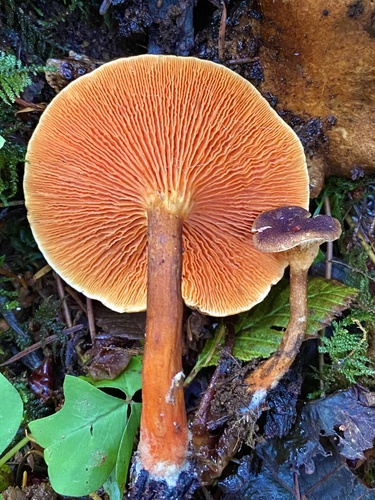
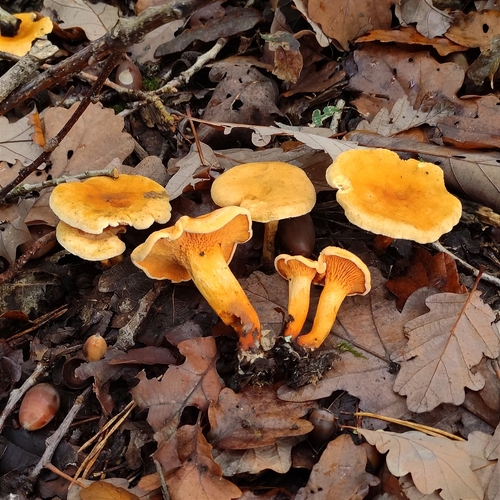
This fungus, Hygrophoropsis aurantiaca, has a golden-orange cap 2–10 cm (3⁄4–4 in) in diameter. The cap starts convex and becomes funnel-shaped as it matures. Its margin stays slightly rolled inward, and becomes wavy or lobed with age, and the cap surface is covered in fine down. Distinctive narrow, forked decurrent gill-like structures are a key distinguishing feature of this species; they are typically a more intense orange shade than the cap, and may be slightly crimped along the stipe. The orange stem (stipe) is 1.5–8 cm (5⁄8–3+1⁄8 in) tall, 0.5–1 cm (1⁄4–3⁄8 in) thick, has no ring, and often has a darker brownish base. Laboratory studies have confirmed that H. aurantiaca can form sclerotia, which are compact masses of hardened fungal mycelium. These structures store glycogen and protein that may act as food reserves during spore germination. The soft, thin flesh of the mushroom ranges in colour from white to yellowish to golden-orange. Its odour and taste are variously described as either indistinct, or unpleasant and earthy. The spore print of this species is white to cream. Spores are oval, measuring 5.5–7 by 4–4.5 micrometres (μm), and their walls tend to thicken with age. Spores are cyanophilous, meaning they stain dark blue readily in methyl blue solution, and staining with Melzer's reagent often produces a dextrinoid reddish-brown colour reaction. Spore-bearing cells called basidia measure 25–40 by 5–8 μm, and can produce two, three, or four spores. Cystidia, large sterile cells found on the hymenium, are absent. The cap cuticle forms a trichoderm: the outermost hyphae run roughly parallel like hairs, perpendicular to the cap surface. These hyphae are 4–15 μm in diameter, and contain intracellular pigments that give the cells an orange-brown to yellow-brown colour. Clamp connections are present in the hyphae. Developmentally abnormal (teratological) forms of H. aurantiaca have been reported in the United Kingdom. The fruit bodies of these abnormal specimens are club-shaped, with a wrinkled upper surface made of convoluted gill tissue. The overall shape of these abnormal forms somewhat resembles species of the genus Clavariadelphus. While the exact cause of this abnormal development is not known with certainty, environmental pollutants or virus infection have been suggested as contributing factors. Hygrophoropsis aurantiaca is a widely distributed species. In Europe and North America, it grows in both hardwood and conifer forests, as well as heathland, during summer and autumn. In North America, it occurs from July to October in eastern areas, and from September to January on the West Coast. It is also found in Central and South America, and Mexico, where it is common in coniferous forests. It has additionally been recorded in northern Asia, Australia, and New Zealand. Populations in California form a complex of undescribed species collectively referred to as Hygrophoropsis aurantiaca sensu lato. This fungus fruits from the ground or decaying wood, and grows in burned forest areas, often found near fallen trees and tree stumps. It can also grow on woodchips used in gardening and landscaping, so it also appears in roadsides and other locations where this material is used. Fruit bodies grow singly, scattered, or in clusters, and can be very abundant. It is generally considered a dry weather mushroom, and can grow in large numbers when other mushrooms are scarce. Hygrophoropsis aurantiaca is a saprophytic fungus, meaning it obtains nutrients from forest litter and decomposing wood, and causes a brown rot on the wood it grows on. It secretes large amounts of oxalic acid, a reducing agent and relatively strong acid. This stimulates weathering of the humus layer of forest soil, influences the solubility and turnover of nutrients (particularly phosphorus and nitrogen), and in turn affects how much of these nutrients is available for forest trees to use.