About Hygromia cinctella (Draparnaud, 1801)
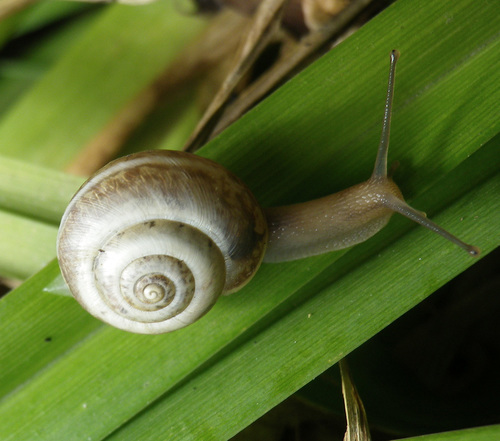
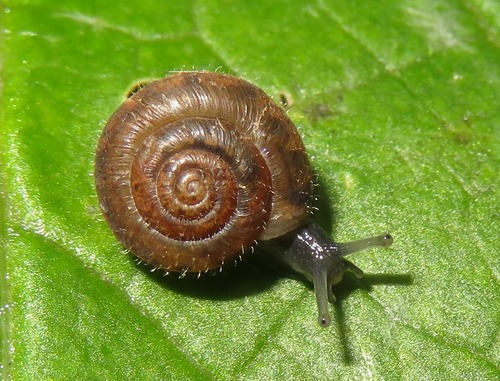
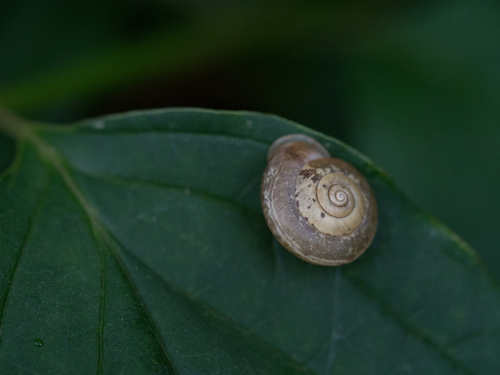
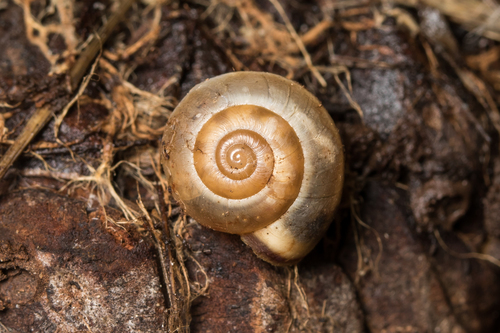
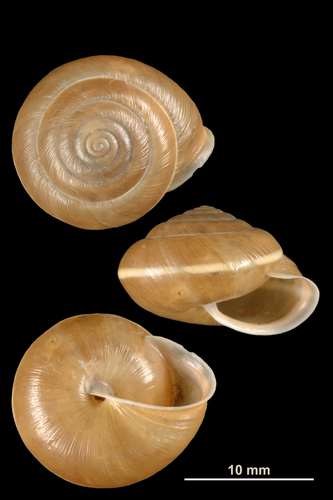
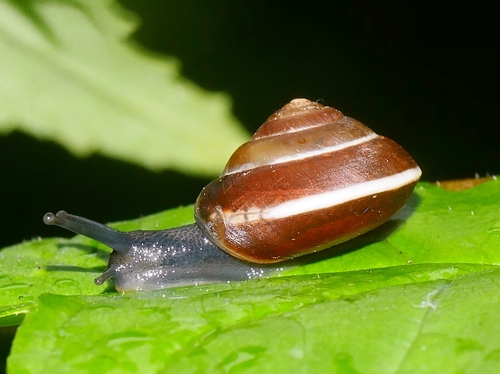
This species, Hygromia cinctella (Draparnaud, 1801), has a dextral shell that measures 6–7 mm in height and 10–12 mm in width. The shell is made up of 5–6 whorls with shallow sutures, forming a high conical apex and a flattened underside. The last whorl has a sharp keel, which features a distinctive white edge that 'girdles' the shell, giving the species its common name. The aperture is simple, with no internal lip. The umbilicus is very narrow, and is almost entirely covered by the reflected columellar margin. Shell colour is variable, ranging from whitish grey to horny brown; specimens often have dark spots, are slightly translucent, and have fine, fairly regular striation. The soft body of the snail is light grey or has a yellowish tint, and the head and tentacles are often a darker grey or brown. In Sicily, observed colour morphs include green, yellow, and reddish forms, some with colour bands. Hygromia cinctella is native to Mediterranean European countries, including southeast France, southern Switzerland, northwest Croatia, Italy, and Slovenia. It has been introduced to and is rapidly becoming established in Great Britain, Austria, Czech Republic, Hungary, Belgium, Germany, the Netherlands, and the United States, and has also been recorded in Ireland. Hygromia cinctella was formally described as new to Britain by writer Alex Comfort, based on specimens he collected in the Paignton area of Devon in April 1950. It was later determined that specimens of this species had been found in the area as early as 1945, but these were misidentified as the closely related congener Hygromia limbata, which is itself a non-native species first discovered in Britain in 1919. The species remained mostly restricted to southeast England until the mid-1970s, when it began to dramatically expand its range. It now has a scattered distribution that extends as far north as Scotland; the first Scottish record was from Glasgow in 2008. In Britain, it tends to prefer human-altered habitats such as gardens, hedgerows, and waste ground. So far, Hygromia cinctella has been found at two sites in Ireland: waste ground west of Cork City, and a garden near Lisburn, where the population appears to persist. The Lisburn population is thought to have been accidentally introduced with garden plants brought from a site near Bristol.