About Hygrocybe virescens (Hesler & A.H.Sm.) Montoya & Bandala
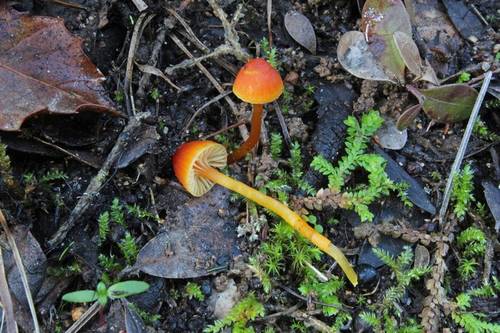
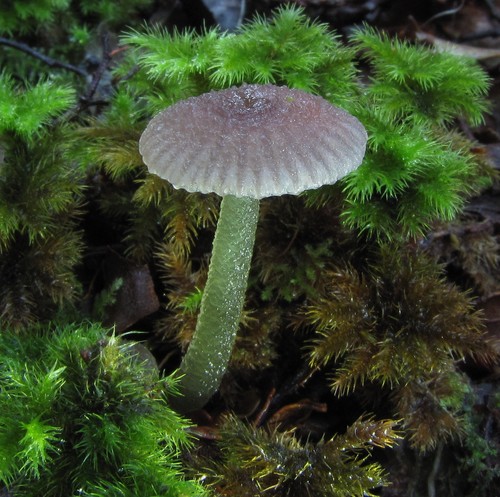
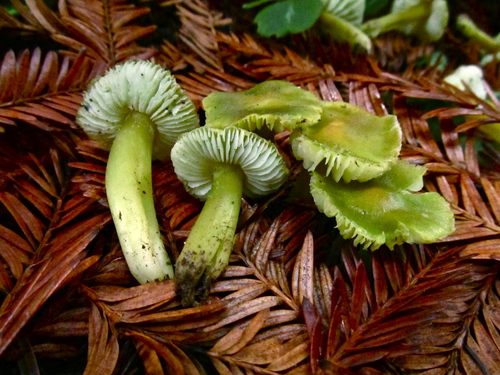
The cap of Hygrocybe virescens is 2 to 5 cm (3⁄4 to 2 in) wide. It is conical or convex when young, and becomes flat when it reaches maturity; the margin often curves upward as the mushroom ages. Cap color is variable: young specimens are yellow with some orange tones, while mature caps turn lime green. The cap surface is smooth, moist but not sticky; as it ages, the margin becomes rimose (covered in a network of small cracks and crevices) and often splits into lobes. The internal context is lime green and very fragile, with no distinctive odor or taste. The gills attach to the stem in an adnexed arrangement, connected to the top of the stipe by a small tooth. They are whitish with lime green tones near the cap, and have paler, serrate (saw-toothed) edges. The stipe (stem) is 3 to 6 cm (1+1⁄8 to 2+3⁄8 in) long, 0.3 to 0.8 cm (1⁄8 to 3⁄8 in) thick, and colored lime green overall. The base of the stem is whitish, and can be either moist or dry; as the mushroom ages, the stem develops vertical grooves or striations. The stem is hollow, and tapers slightly in width toward its top. The spores are ellipsoid, smooth, and inamyloid, measuring 7–10 by 5–6.5 μm. The spore-bearing basidia measure 40–55 by 7–10 μm, and can be either 2- or 4-spored. This species has neither pleurocystidia nor cheilocystidia. Hygrocybe virescens has a confirmed limited distribution: it is found in California, Washington (known from a single collection in Seattle), and Veracruz State, Mexico. In California and Washington, it fruits in association with redwood trees. Mexican collections were found growing among grass and in gardens, near cypress hedges of the genus Cupressus. The species is rarely collected.