About Hygrocybe chlorophana (Fr.) Wünsche
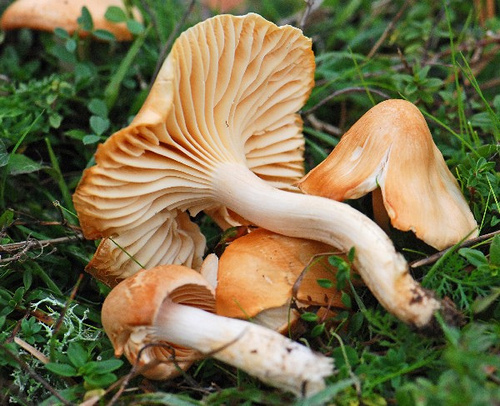
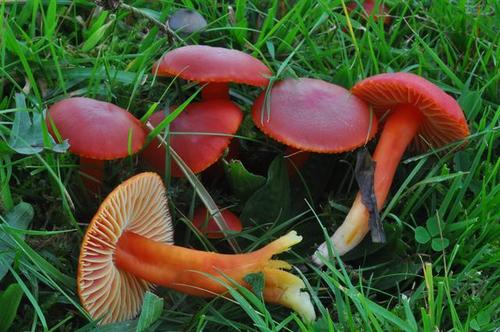
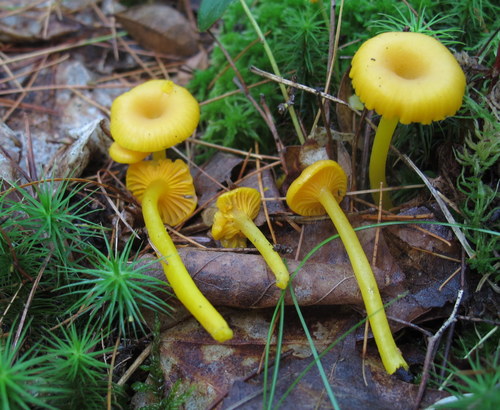
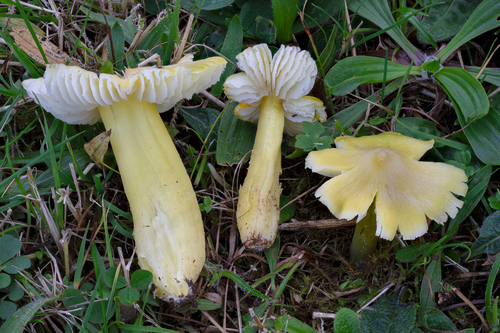
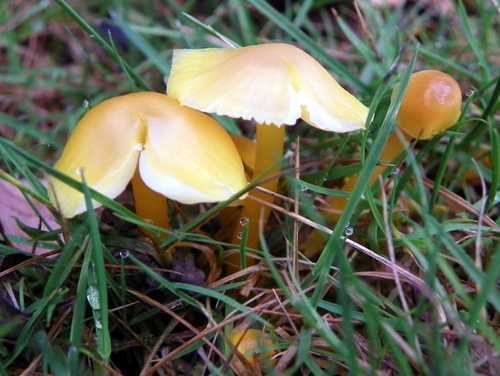
The basidiocarps of Hygrocybe chlorophana are agaricoid, growing up to 10 cm (4 in) tall. The cap is convex when young and never conical, flattening out as it expands, reaching up to 7.5 cm (3 in) across. Its surface is smooth, distinctly viscid when damp, and colored bright lemon-yellow to orange-yellow, rarely orange to red. The gills (lamellae) are waxy, pale and matching the cap's color, and adnexed, meaning they are narrowly attached to the stem (stipe). The stipe is smooth, cylindrical or compressed and grooved, matches the cap's color, and is moist to somewhat viscid when damp. This species produces a white spore print. Under a microscope, the spores are smooth, inamyloid, and ellipsoid, measuring approximately 7.5 to 9.0 by 4.0 to 5.5 μm. Hygrocybe chlorophana, commonly called the golden waxcap, is widespread across the north temperate zone, and has been recorded in Europe, North America, and northern Asia. It has also been collected from alpine areas of Mount Wellington in Tasmania, Australia. Like other waxcaps, in Europe it grows in old, unimproved, short-sward grassland such as pastures and lawns, while in North America and Asia it grows in woodland. Recent research indicates that waxcaps are neither mycorrhizal nor saprotrophic, and may be associated with mosses.