About Hydrophasianus chirurgus (Scopoli, 1786)
The scientific name of the pheasant-tailed jacana is Hydrophasianus chirurgus (Scopoli, 1786).
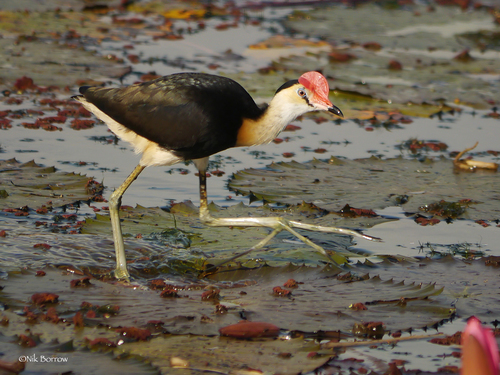
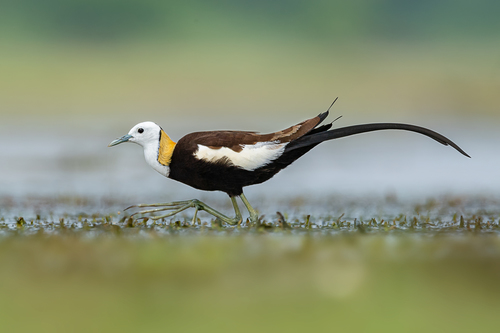
Description The pheasant-tailed jacana is conspicuous and cannot be mistaken for any other species. When its elongated tail streamers are included, it is the longest species in the jacana family. Its breeding plumage features elongated central tail feathers, which give the species its name. In breeding plumage, the body is chocolate brown, the face is white, and the back of the crown is black, with white stripes running down the sides of the neck. These stripes separate the white of the front neck from the silky golden yellow of the nape. The wings are predominantly white. In flight, the white wing shows a black border, which is formed by black coloration on the outermost primaries and the tips of the outer secondaries and primaries. The wing coverts are pale brown, and the scapulars may have a green or purple gloss. In the non-breeding season, the top of the head and back are dark brown, and only a faint trace of the golden nape feathers can be seen. A dark eyestripe runs down the sides of the neck and forms a dark necklace on a slightly dulled white front neck. The outer two primaries have a slender (lanceolate or spatulate) extension that broadens at the tip. The fourth primary has a sharp tip formed by the feather shaft after the webbing is lost.
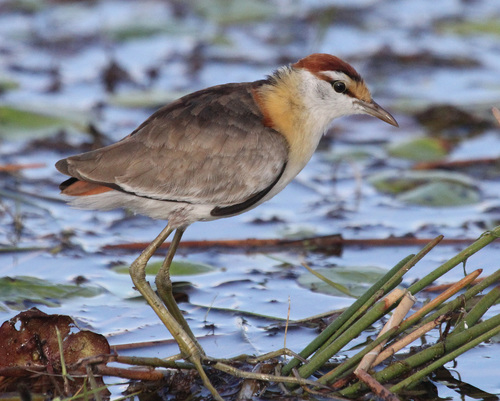
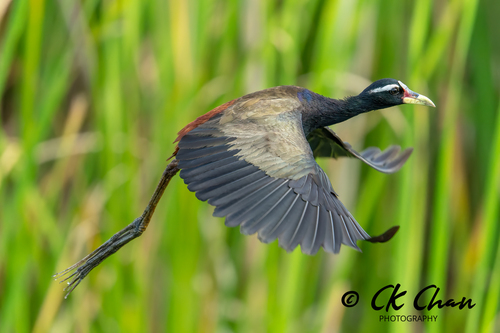
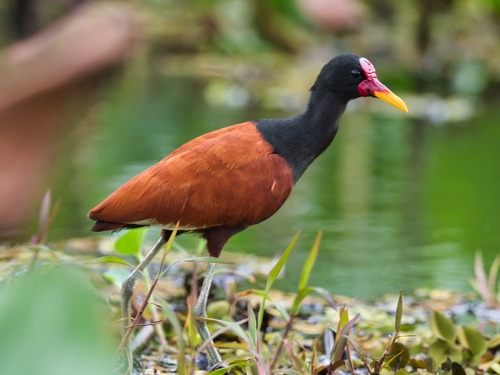
Young birds have brown upperparts, and their dark necklace is broken. Faint traces of the black stripe on the side of the neck and all-white wings distinguish them from similar-looking juvenile bronze-winged jacanas. Pheasant-tailed jacanas have strongly developed, sharp white carpal spurs, which are longer in females. The spurs may moult, but this moult process has not been specifically described for this species. The tail is short and strongly graduated. The bill is more slender than that of the bronze-winged jacana; it is bluish-black with a yellow tip during breeding season, and dull brown with a yellowish base during non-breeding season. The legs are dark bluish grey, and the iris is brown.
Shufeldt described the skeleton of a specimen from Luzon: it is typical of jacanas, but the skull resembles that of sandpipers in some ways. Only the skull and mandibles are slightly pneumatized, which is not the case for the other bones. The sternum has a notch on the side that serves as an attachment point for long, slender xiphoidal processes.
Distribution and habitat The pheasant-tailed jacana is a resident breeder in tropical India, Southeast Asia, and Indonesia. Its range overlaps extensively with that of the bronze-winged jacana, but unlike the bronze-winged jacana, the pheasant-tailed jacana is found in Sri Lanka. It inhabits small to large lakes that have sufficient floating vegetation. Most populations across its range are sedentary, but northern breeding populations from south China and the Himalayas migrate south from their breeding ranges to Southeast Asia and peninsular India, respectively. In Nanking, the birds leave in November and return for the summer in the third week of April, and some birds arrive while still in non-breeding plumage. The species is resident in Taiwan, where it is considered endangered. The birds disperse in summer, and have been recorded as vagrants in Socotra, Qatar, Australia and southern Japan (mainly Okinawa, Yonaguni, Ishigaki and Iriomote). The species tends to be more common at lower elevations, but moves up into the Himalayas in summer. There are records of the species at altitudes of 3650 m at Vishansar Lake in Kashmir and 3800 m in Lahul.
Behaviour and ecology The main food sources of the pheasant-tailed jacana are insects, molluscs, and other invertebrates picked from floating vegetation or the water surface. It forages by walking on floating vegetation and also by swimming in water, in a manner similar to phalaropes, though Hoffmann claims that the species wades in deeper water but never swims. It also ingests filamentous algae, seeds and plant material, but this ingestion is likely purely accidental. Flocks of 50 to 100 individuals can be found on a single body of water, and the birds can become tame and habituated to human presence. They usually fly low over the water surface, but may also mob raptors at higher altitudes. When landing, they keep their wings open until they find firm footing. The typical call is a mewing me-onp, or a nasal teeun among winter flocks. Males and females produce different calls during the breeding season, and there are several context-specific call variants. Young birds produce a low cheep with their bill closed.