About Hydromys chrysogaster É.Geoffroy, 1804
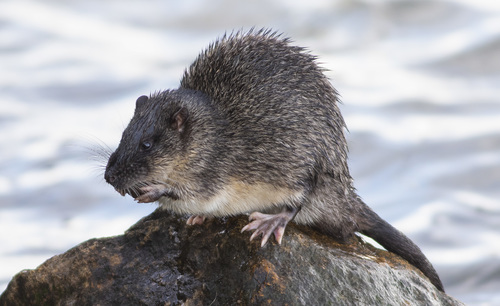
Hydromys chrysogaster, scientifically named by É.Geoffroy in 1804, is the most aquatically specialized member of the rodent group Hydromyini. This species has a flattened head, partially webbed hind feet, and water-repellent fur that also provides insulation. Its thick waterproof coat ranges from very dark black to slate grey on the back, and white to orange on the underbelly. A key identifying trait is its thick dark tail with a white tip. Moulting patterns for this species differ by sex: both males and females moult in autumn and summer, while females also moult in spring. Moulting depends on temperature, reproductive condition, adrenal weight, health, and social interaction. Additional distinguishing features include wide partially webbed hind feet, a broad face, and long whiskers. Excluding the tail, the body grows to around 39 cm (15 in) long. This well-adapted semi-aquatic species is territorial and mostly solitary, and may become very aggressive in high-density populations. Fighting is common, which often leaves bitten, scarred tails on both adult males and females. Affected individuals often develop ulcerated wounds, subcutaneous cysts, and tumours, most often on the dorsal and posterior regions of the body. This is a widespread species found along permanent water systems in Australia, New Guinea, and nearby offshore islands. Also called rakali, the species lives near permanent water across a diverse range of habitats, including slow-moving freshwater streams, brackish inland lakes, creeks, wetlands, rivers, estuaries, and coastal beaches. It is found in all Australian states and territories, and adaptable resettling populations of the species exist in both Australia and New Guinea. It is widely distributed across most of eastern Australia (including Tasmania), along the coast of northern Australia (except the Pilbara region), and in south-west Western Australia. Its habitats cover freshwater streams, brackish wetlands, shallow lakes up to 2 m (6 ft 7 in) deep, farm dams, deep water storages, slow-moving rivers, creeks, estuaries, coastal lakes, and sheltered marine bays. An individual’s home range typically covers 1–4 km (0.6–2.5 mi) of waterways, and they can travel between 200 m (660 ft) and 1 km (0.6 mi) in a single night while foraging. They prefer low banks with flat, densely vegetated water edges for protection and easier prey stalking, and rest in hollow logs and burrows when they are not foraging.