About Hydromantes platycephalus (Camp, 1916)
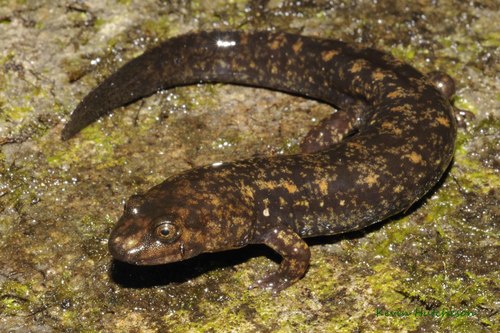
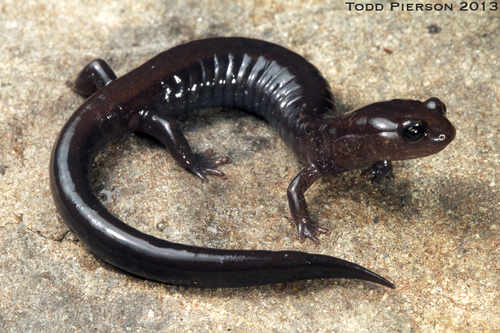
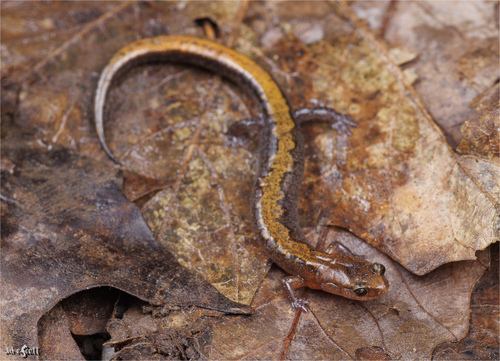
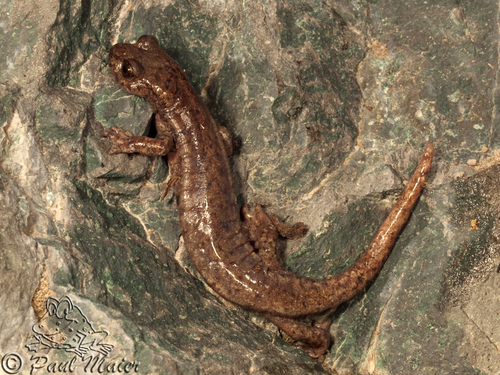
The Mount Lyell salamander, scientifically named Hydromantes platycephalus, has a flat, slender body that is deep brown-black, with grey-green mottling on its back. Juveniles usually have more gold-green mottling, and there is wide variation in coloration across individual salamanders. Regional populations typically have mottling that matches the color of local granite. As the species epithet platycephalus (meaning "flat head") suggests, its head is noticeably flattened. Like other members of the Hydromantes genus, it has webbed toes, short legs, and a stubby tail. Adults reach a total length of approximately 120 millimetres, or 4.7 inches. The species usually has 12 to 13 costal grooves. Populations on the eastern slopes of the Sierra Nevada differ slightly in coloration from those on the western slopes. Western slope individuals typically have speckled mottling, while eastern slope individuals have more continuous, blocky mottling; some eastern slope individuals even have a completely solid-colored back. Eastern slope individuals were once thought to potentially belong to a separate species called the Owens Valley web-toed salamander, but this classification is no longer recognized. Contrary to its common name, the Mount Lyell salamander is not endemic only to Mount Lyell, though its entire range is restricted to California. It occurs from roughly Alpine County to Tulare County, California, at elevations between 1,200 metres (3,900 ft) and 3,600 metres (11,800 ft). Because it lives in hard-to-access high-elevation terrain, the species' full range is not well mapped, and new populations are still being discovered. For example, a population in Blackwood Canyon of the Lake Tahoe Basin filled a major gap in the species' known distribution and marked the first record of the species in Placer County; this population was not discovered until 2006. A large share of observations of this species come from the Yosemite National Park area, due to the park's accessibility and high number of visitors and observers. The Mount Lyell salamander is most often found in high-elevation rocky areas with very little topsoil. Individuals use a variety of microhabitats, including exposed rock, talus slopes, rock fissures, caves, crevices, and spaces under rocks. Like other plethodontid salamanders, the Mount Lyell salamander is lungless and breathes through its skin. This means it needs consistent access to moisture, so it is often found near water sources such as melting snow, spring run-off, or waterfalls. At lower elevations, the species is more strongly associated with riparian corridors. Vegetation including moss, forbs, lichen, ferns, wildflowers, heather, willow, and scrubby pines may be present in the species' habitat, though large shrubs and trees are generally uncommon. Individuals appear to have very small home ranges, possibly even less than 100 metres (330 ft) across. In 2006, two biologists found an individual near Nevada Falls in Yosemite National Park, where the species had not previously been reported. When they returned to the same location ten years later in 2016, they found another individual within 10 metres (33 ft) of the original 2006 observation. The reproductive habits of the Mount Lyell salamander are not well documented. It is thought that females lay 6 to 14 eggs in deep rock crevices during fall, and guard the eggs until they hatch in spring or early summer. Museum specimens of female salamanders collected in summer have contained 6 to 14 eggs, and apparent hatchlings have been found in summer. The act of egg-laying (oviposition) has never been observed in this species.