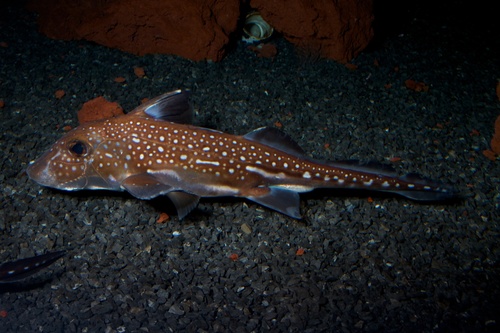
About Hydrolagus colliei (Lay & Bennett, 1839)
Hydrolagus colliei, commonly called the spotted ratfish, has a very distinct appearance compared to unrelated fish species. Females grow up to 97 cm (38 in) long, and are much larger than males. These fish have smooth, scaleless skin that is silvery-bronze, often with sparkling gold, blue, and green hues. Speckled white spots along their backs give the species its common name. Both the caudal and dorsal fins have dark outlined edges, while the pectoral fins have transparent edges. Their pectoral fins are large, triangular, and extend straight out from the sides of their bodies like airplane wings. A venomous spine sits on the leading edge of their dorsal fin, which the fish uses for defense. This spine does not pose a serious danger to humans, but it can cause painful wounds. It has been recorded killing harbor seals that eat spotted ratfish, when the spine penetrates vital tissue in the seal's stomach or esophagus after the ratfish is swallowed. The spotted ratfish's tail makes up almost half of its total body length, and closely resembles a pointed, rat-like tail. The fish's body is supported by cartilage instead of bone. It has a duckbill-shaped snout and a rabbit-like face. Its mouth is small, with one pair of forward-pointing, incisor-shaped teeth in the lower jaw and two pairs in the upper jaw. Unlike sharks, which have sharp, easily replaceable teeth, spotted ratfish teeth are plate-shaped, mineralized, and permanent, helping the fish grind prey. Like many bony fishes, but unlike the spotted ratfish's sister group Elasmobranchii, the upper jaw of this chimaera is fused to the skull. Though the fish's jaws are soft and its mouth is relatively small, it has the largest biting force and jaw leverage of any species in Holocephali, which supports its ability to eat large prey. One of the species' most striking features is its large, emerald green eyes, which can reflect light similar to a cat's eyes.
Spotted ratfish are found in the northeastern Pacific Ocean, ranging from Alaska to Baja California, with an isolated population in the Gulf of California. They are abundant across most of their range, and are most common off the Pacific Northwest. They can be found at depths from 0 to 913 m (0 to 2,995 ft) below sea level, but are most common between 50 and 400 m (160 and 1,310 ft). In the northern part of their range, spotted ratfish typically live closer to shore than they do in the southern part of their range, but they can be found as shallow as 30 m (98 ft) off California. Spotted ratfish tend to move into shallower water during spring and autumn, and move to deeper water during summer and winter. For most of the year, they prefer water temperatures between 7.2 and 8.9 °C (45 and 48 °F), but they seasonally move into slightly warmer water. They are most commonly found near the sea floor in sandy, muddy, or rocky reef environments. Unlike most of its close relatives, which are restricted entirely to deep water, spotted ratfish can be kept in public aquaria. They have even been bred in aquaria, where the main requirements to keep them are low light and low temperature (they are generally kept at 8–12 °C or 46–54 °F).
Like some sharks, spotted ratfish are oviparous. Their spawning season peaks between spring and autumn. During this period, females release up to two fertilized eggs into sandy or muddy areas of the seabed every 10–14 days. The egg extrusion process can last 18–30 hours, and the actual laying process can last another 4–6 days. The egg case is leather-like, 12.7 cm (5.0 in) long, and has a filament that attaches the egg to the ocean floor after the mother releases it. Females may sometimes swim around their newly laid eggs to keep predators from finding them. Egg development can take up to a year, which carries risk because divers sometimes mistake the eggs for inanimate objects. When young ratfish hatch, they are about 14 cm (5.5 in) in length, and grow to reach 30 cm (12 in) long by their first year.
Male spotted ratfish have several secondary sexual characteristics, including paired pelvic claspers, a single frontal tentaculum, and paired pelvic tentacula. Pelvic claspers are located on the ventral side of the fish. They protrude from the pelvic fins and function to transfer sperm to the female's oviduct. The interior of a pelvic clasper is supported by cartilage and splits into two branches, ending in a fleshy lobe at the posterior end. The cephalic clasper, or frontal tentaculum, is a unique club-shaped organ not found in any other vertebrate. It is located on the fish's head just in front of the eyes. The tip of this retractable organ is fleshy and lined with many small, sharp barbs. To stay attached to the female during mating, the clasper clamps down on the female's pectoral fin; scars and scratches on the dorsal sides of females provide additional evidence of this behavior. The significantly smaller body size of males, a sexually dimorphic trait of the species, may be a contributing factor to this mating behavior.

