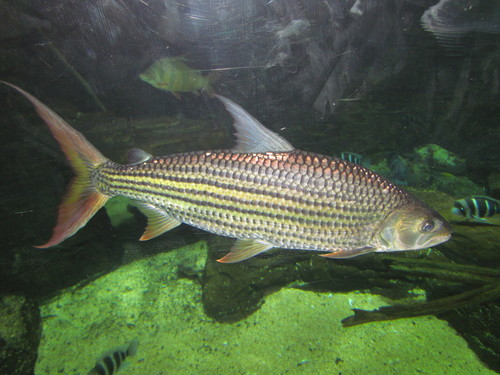
About Hydrocynus vittatus Castelnau, 1861
Hydrocynus vittatus is an overall silvery fish, with thin black stripes running horizontally across its body. It has an elongated body, and a red, forked caudal fin that has a black edge. This fish has a large head and correspondingly large teeth, with eight teeth per jaw. The teeth are sharp and conical, and are used to grasp and chop prey. H. vittatus can replace all of its teeth at the same time, in both the upper and lower jaws. Males of this species are larger and more full-bodied than females. It reaches a maximum recorded length of 105 centimetres (41 in) standard length. H. vittatus is distributed across the Niger/Bénoué system, Ouémé River, Senegal River, Nile, Omo River, Congo River, Lufira, Lualaba River, Luapula, Zambezi, Limpopo River, Rovuma, Shire River, and Wami River. It also occurs in multiple lakes: Lake Bangweulu, Lake Mweru, Lake Tanganyika, Lake Upemba, Lake Rukwa, and Lake Malagarazi. Additional populations are found in the Okavango Basin, the lower reaches of coastal systems extending south to the Pongola River, and the man-made reservoirs Lake Kariba, Lake Jozini and Schroda Dam. The species is common and widespread across most of its range. The most studied H. vittatus population is located in Lake Kariba on the Middle Zambezi River; here, the population fluctuates dramatically, in apparent direct correlation to the abundance of introduced clupeid Limnothrissa miodon, which makes up a major portion of the fish's diet.

