About Hydrocoloeus minutus (Pallas, 1776)
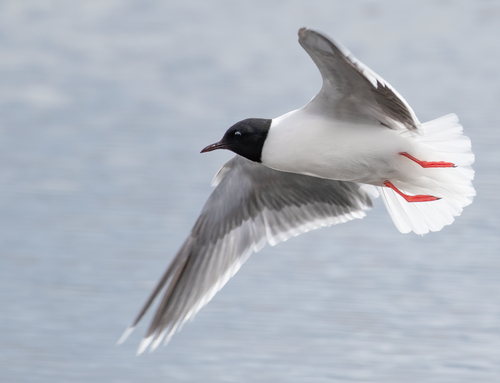
The little gull (Hydrocoloeus minutus) has a body length of 24 to 28 cm (9.4 to 11.0 in) and a wingspan of 62 to 69 cm (24 to 27 in), making it the smallest gull species in the world. Adult little gulls in breeding plumage have a black hood, dark red bill, bright red legs, and sometimes a rosy flush on the underside. In non-breeding plumage, adults have a black cap and an ear spot, white underparts, a black bill, and duller red leg coloration. Across all plumages, adults have a pale grey back and upperwings with white primaries that contrast with a very dark grey underwing. Juveniles have large blackish areas on the back and head; in flight, they show a dark "w" pattern on the upperwings and have white underwings. By their first winter, their head and body are similar to adult little gulls, but they retain the juvenile upperwing pattern. By their second year, they are very similar to full adults, but still have some black primary feathers. The little gull has a wide Palearctic distribution, breeding from northern Scandinavia and the eastern Baltic Sea to eastern Siberia. They also breed in North America around the Great Lakes. This is a migratory species that winters along the coasts of Europe as far south as the Mediterranean, Black, and Caspian Seas. They are uncommon in the western Pacific. In North America, they winter along the Atlantic coast in small numbers, reaching as far south as the Carolinas. In the early 21st century, increasing numbers of non-breeding little gulls have summered in western Europe. In 2016, the species successfully nested for the first time in Great Britain at the RSPB Loch of Strathbeg reserve in Aberdeenshire; the birds returned for a few days in May 2017 but did not breed again. The little gull nests in dense vegetation growing in shallow freshwater bodies, slow-moving rivers, marshes, and bogs that have emergent or floating-leaf plants. It occasionally uses coastal lagoons or other brackish water habitats for nesting. During migration, this species is typically coastal but may occur inland under some conditions. It winters on coasts with sand and mud substrates, at river mouths, and even out to sea, and may be attracted to sewage outfalls.