About Hydrangea serrata (Thunb.) Ser.
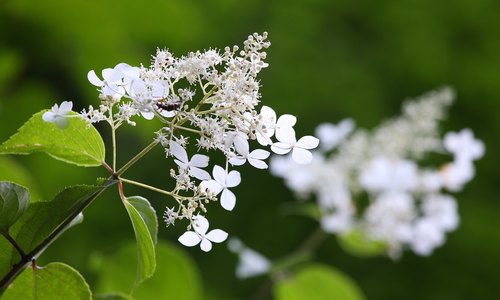
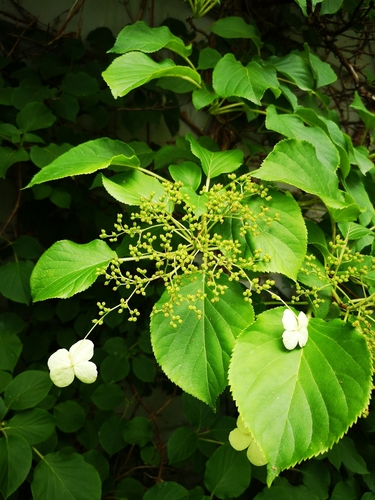
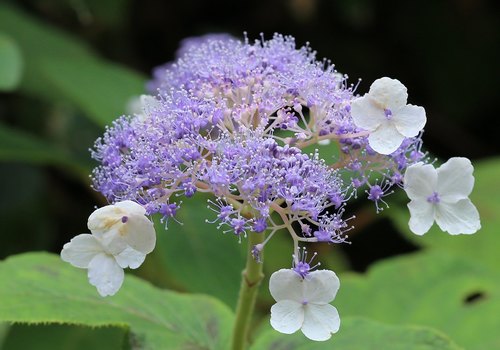
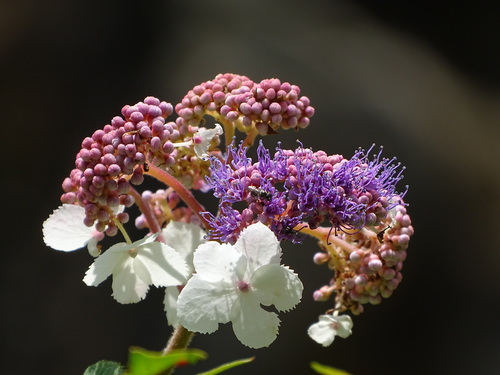
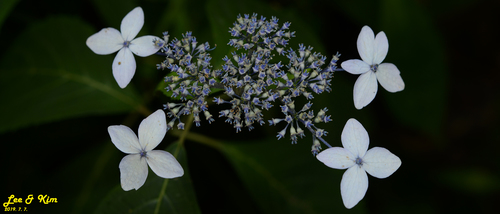
Hydrangea serrata is a flowering shrub that resembles H. macrophylla, but is smaller, more compact, has smaller flowers and leaves, and is hardier. It grows with a rounded habit, and has dark green, serrated (toothed), ovate leaves that reach up to 15 cm (6 in) long. From mid- to late summer, it produces long-lasting clusters of lacy blue or pink flowerheads. Each cluster contains both showy sterile florets and less visible fertile florets. These perfect flowers have both male and female reproductive parts, and are pollinated by insects. For cultivation, Hydrangea serrata grows best in rich, medium-moisture, well-drained soils located in partial shade. It can tolerate full sun only if it is consistently grown in soil with steady moisture. Soil pH affects flower color the same way it does for H. macrophylla: flowers turn bluish in highly acidic soils, and lilac to pink in soils that range from slightly acidic to alkaline. On neutral soils, careful use of soil additives can create limited color changes for pink and blue varieties. Flowers form on old wood, so this plant requires very little pruning. If pruning is needed, it can be done after flowering by cutting flowering stems back to a pair of healthy buds. Weak or winter-damaged stems can be pruned in early spring. It is winter hardy to USDA Zone 6; it can be grown in USDA Zone 5 when given winter protection such as mulch or a burlap wrap. In harsh winters, it may lose a large number of flower buds or die back to the ground, which reduces or eliminates blooms the following growing season. Dormant plants are hardy to around −25 °C (−13 °F), but young spring growth can be killed by late frosts. Hydrangea serrata works well as a specimen or accent plant for protected sites near homes or patios. It can be grown as a low hedge, and it has good wind tolerance. The leaves of this mountain hydrangea contain phyllodulcin, a natural sweetener, and are used to make regionally popular herbal tisanes. Amacha, an herbal tea used in Japan to celebrate the birth of Buddha, is made from H. macrophylla var. thunbergii. In Korea, H. serrata, known locally as sansuguk (산수국; 山水菊), is used to make an herbal tea called sugukcha (수국차) or isulcha (이슬차).