About Hydrangea radiata Walter
This species is commonly called silver hydrangea or silverleaf hydrangea, with the scientific name Hydrangea radiata Walter.
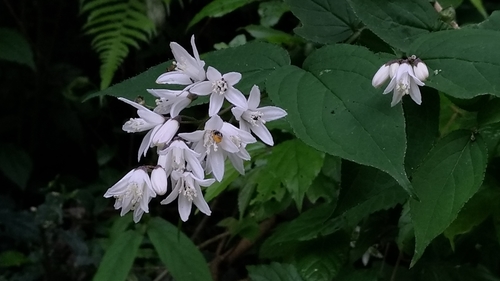
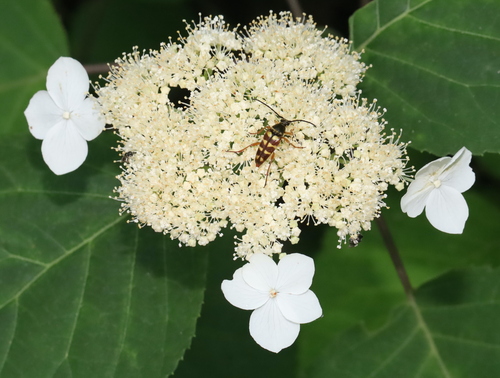
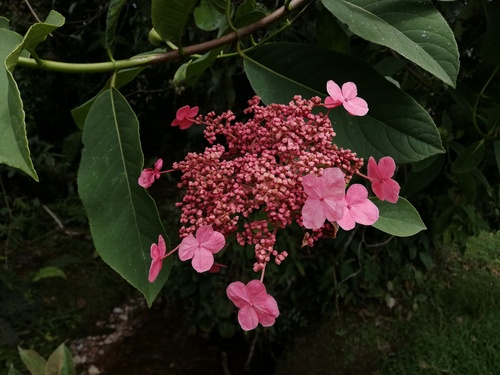
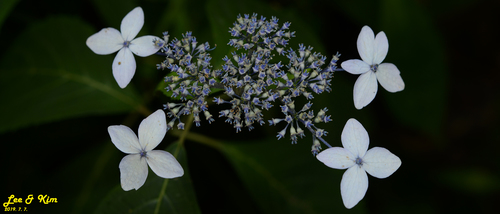
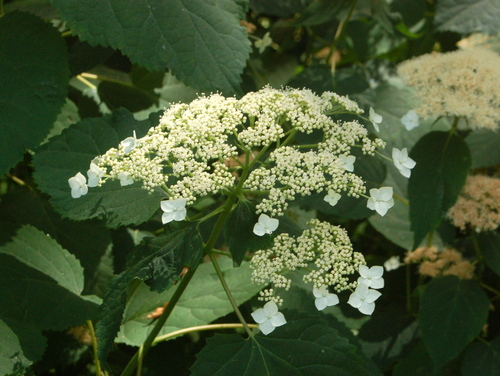
Its inflorescence takes the form of a corymb. Showy, white to near-white sterile flowers are comparatively abundant, with 2 to 15 per bloom, and grow around the corymb's periphery. These sterile flowers are usually more than 1 cm in diameter.
Silverleaf hydrangea has opposite, serrated, ovate deciduous leaves that are 8 to 15 cm (3 to 6 inches) long. The upper leaf surface has hairs along the veins, while the lower leaf surface is densely covered in felt-like hairs that give it a bright white or silver appearance. When viewed under magnification, these hairs lack tubercles, which distinguishes this species from ashy hydrangea, which has numerous tubercles on its hairs. The hairs are so dense that the lower leaf epidermis cannot be seen through them.
Silver hydrangea is native to mountainous regions typically above 2,000 feet (610 m) elevation. Its native range covers the southern Blue Ridge Mountains, extending from southeast Tennessee east to North Carolina and northwestern South Carolina, and south to northeastern Georgia. It most often grows near streams, on rocky outcrops, and along roads, and is especially common in the headwaters of the Chattooga River and the French Broad River Valley. It is easily spotted along roadsides near the junction of North Carolina, South Carolina, and Georgia, in the area around Highlands, Cashiers, and Rosman, North Carolina. A small number of outlier populations have been observed in the Piedmont Region, and these populations may have escaped from cultivation.
This attractive shrub has significant landscaping potential for regions with appropriate climate and soil. It requires cool, moist shaded habitats, and is less tolerant of heat and drought than smooth hydrangea. It is also more difficult to root from cuttings than either smooth hydrangea or ashy hydrangea. It produces more showy flowers than both smooth hydrangea and ashy hydrangea. It is suitable for hardiness zones 4 to 9, though highly protected locations are recommended for growing in areas warmer than zone 6. Several popular cultivars are available, including Samantha and Terri Greer.