About Hydrangea quercifolia Bartram
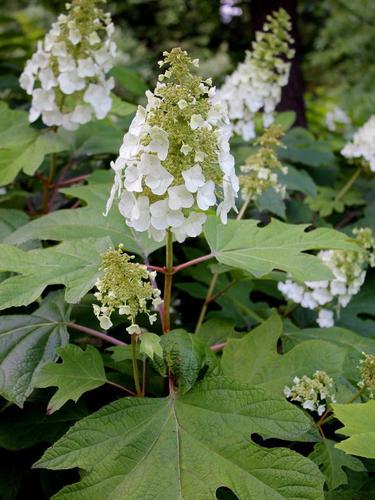
Hydrangea quercifolia Bartram is a coarse-textured deciduous shrub that grows 0.91–3.66 m (3–12 feet) tall, with an open crown. This plant sprouts new shoots from underground stolons and often grows in colonies. Young stems are covered in felt-like light brown bark, while larger stems have attractive cinnamon-tan-orange bark that shredds and peels in thin flakes. The leaves are yellowish green to dark green on their upper surface, and silvery-white underneath. They have three, five, or seven pointed lobes, measure 10.2–30.5 cm (4–12 in) long and are almost as wide. They vaguely resemble larger versions of oak leaves, similar to the lobed foliage of Quercus species. Plants grown in shade develop larger leaves than those grown in full sun. In autumn, leaves turn rich shades of red, bronze, and purple, and these dried leaves persist through winter alongside persistent dried flower heads. Hydrangea quercifolia is native to the southeastern United States (western Georgia, eastern Louisiana, Alabama, Florida, Mississippi, North Carolina, South Carolina, Tennessee), and has become naturalized in other parts of the US, while being widely cultivated in other regions worldwide. In its natural habitat, it grows in a range of locations, but almost always occurs on well-drained, shady slopes. These habitats include riverbanks, bluffs, and rocky outcroppings. Its ability to grow on calcareous soils, calcareous cliffs, and deep alluvial soil indicates it tolerates a wide range of soil substrates as long as the soil is well drained. Hydrangea quercifolia is grown as an ornamental plant for gardens and parks. While it is often planted as a single isolated specimen in gardens, it looks its best when grown in natural or landscaped woodland settings against a backdrop of larger shrubs and trees. It prefers partial to almost full shade, with morning sun and afternoon shade being optimal growing conditions. It can tolerate drought, but drought may prevent it from producing flowers. In the United Kingdom, the cultivars Snowflake='Brido' and Snow Queen='Flemygea' have received the Royal Horticultural Society's Award of Garden Merit. This species is propagated via cuttings or division; short sections of clustered stems with some attached roots will grow into a small shrub when planted in a nursery row. Whether fresh or dried, the blossoms of Hydrangea quercifolia are attractive for use as cut flowers.