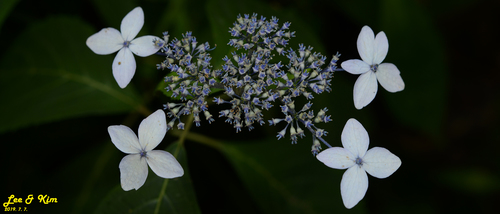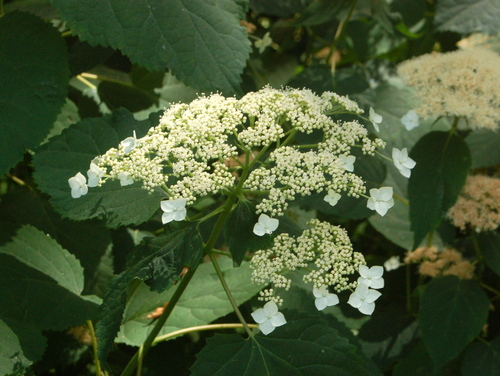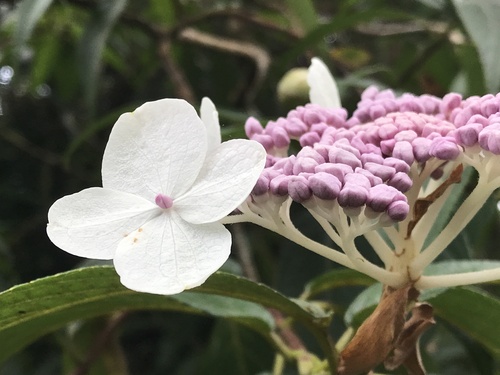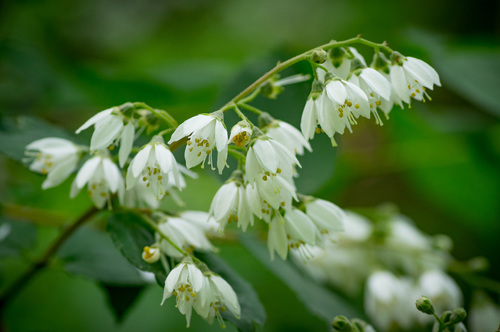
About Hydrangea petiolaris Siebold & Zucc.
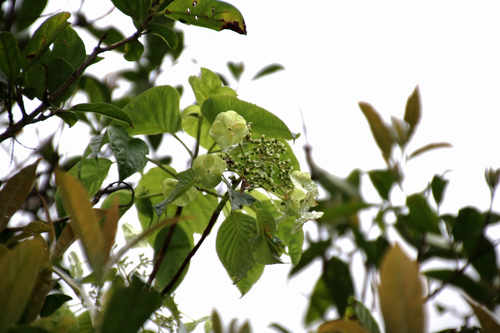
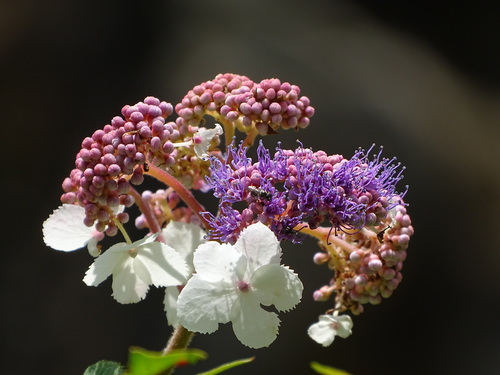
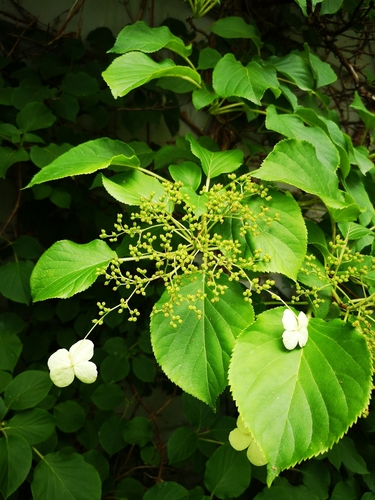
Hydrangea petiolaris Siebold & Zucc. is a vigorous woody climbing vine that reaches 9 to 15 meters (30 to 50 feet) in height, and 2 meters (5 to 6 feet) in width. In its native Asian habitats, it climbs trees and rock faces using small aerial roots that grow from its stems. Its leaves are deciduous, ovate, 1.6 to 4.3 inches (4 to 11 cm) long and 1.2 to 3.1 inches (3 to 8 cm) broad. Each leaf has a heart-shaped base, coarsely serrated edges, and an acute tip. Flowers form flat corymbs 5.9 to 9.8 inches (15 to 25 cm) in diameter during mid-summer. Each corymb holds a small number of outer sterile white flowers 1.0 to 1.8 inches (2.5 to 4.5 cm) across, and many tiny off-white fertile flowers just 1 to 2 millimeters in diameter. The fruit is a dry urn-shaped capsule 3 to 5 millimeters in diameter that holds several small winged seeds. This species is cultivated as an ornamental plant in Europe and North America. It is grown on masonry walls, sturdy trellises, or fences. It grows best in locations with morning sun and afternoon shade, but it can tolerate dense shade, so it is often planted in shady, north-facing areas that receive little or no sun. Its clinging rootlets are not as strong as those of some other wall-climbing vines, so it is often secured with additional gardening ties. Outward-reaching side shoots can be pruned back to a pair of buds to train the vine to lie flatter against its support. When pruned during flowering, the cut blooms can be used in bouquets. It can also be grown as a ground cover, and will eventually spread to cover an area of up to 19 square meters (200 square feet). It is hardy in USDA climate Zone 4a, meaning it can withstand minimum temperatures between -34.4 °C (-30 °F) and -31.7 °C (-25 °F). The young leaves of this climbing hydrangea are edible after cooking, with a cucumber-like flavor, and are sometimes added to miso in Japan.