About Hydrangea macrophylla (Thunb.) Ser.
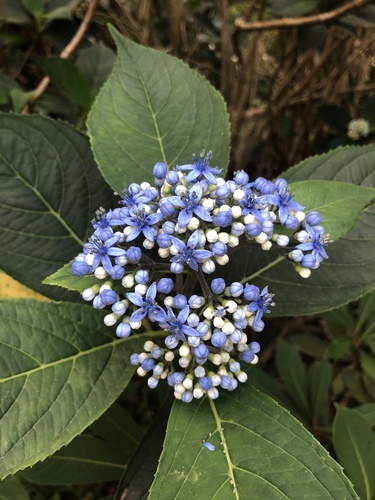
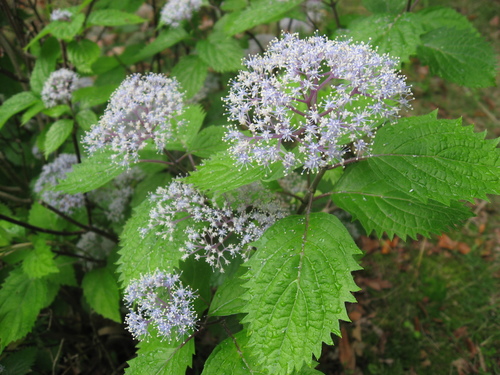
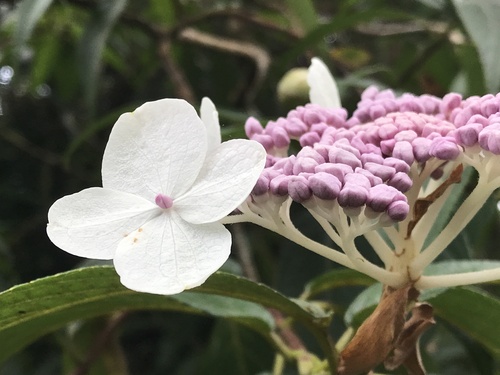
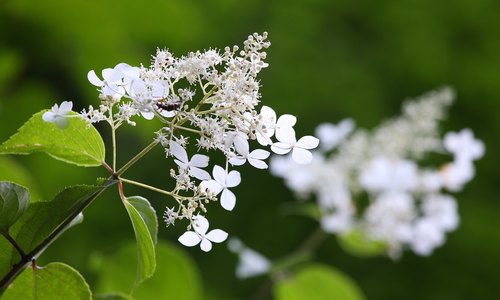
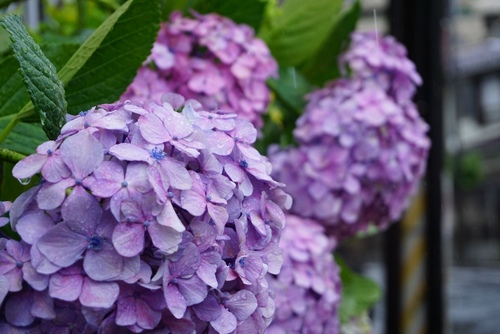
The epithet "macrophylla" in Hydrangea macrophylla (Thunb.) Ser. means "large- or long-leaved". This species has opposite, simple, membranous leaves that can reach 15 cm (6 in) in length, with shapes ranging from orbicular to elliptic, pointed tips, and generally serrated margins. Wild Hydrangea macrophylla naturally forms flat-topped corymb inflorescences, with all flowers arranged on a single plane. It produces two distinct flower types: numerous small, fertile, five-parted flowers in the center, and a small number of larger, four-parted flowers on the inflorescence edges. These outer larger flowers are usually sterile, and their color ranges from whitish to pale blue or pinkish. The small fertile flowers have five small greenish sepals and five small petals. Flowering starts in early summer and continues through to early winter, and the mature fruit is a nearly spherical capsule. As a widely cultivated ornamental plant, hundreds of cultivars have been developed from this species. More than 500 of these cultivars have replaced the small central fertile flowers with large, mostly or fully sterile four-parted flowers, resulting in hemispherical or fully rounded inflorescences instead of the original flat form. This cultivar group is commonly called "mophead" or "hortensia" hydrangeas, and their large flowers show a wide color range from pale pink to red, fuchsia, purple, and blue. A smaller group of over 20 cultivars, known as "lacecap" hydrangeas, retain the natural flat inflorescence structure: small central flowers surrounded by a ring of large sterile outer flowers, but they have more intense flower colors than wild plants. Many cultivars, especially those bred for better cold tolerance, originate from hybrids between Hydrangea macrophylla and Hydrangea serrata, a mountain hydrangea native to Japan. Hydrangea macrophylla is endemic to Japan, where it grows in coastal habitats from Honshu southward. Natural wild populations, formerly sometimes classified as H. macrophylla var. normalis E.H.Wilson, naturally have the lacecap inflorescence structure: a small number of large, showy, sterile bract-like flowers that attract pollinators surrounding a central cluster of small fertile flowers. Hydrangea serrata, a closely related hydrangea from the interior mountains of Japan, was previously treated as a variety of H. macrophylla by some botanists, but it is currently recognized as a separate species. H. macrophylla has become naturalized in China, Korea, Siberia, New Zealand, and the Americas, and has established as an invasive species in the Azores and Madeira archipelagos. In Japan, the beverage amacha is made from fermented leaves of Hydrangea macrophylla var. thunbergii. The processed medicinal product Hydrangeae Dulcis Folium is also made from the fermented and dried leaves of this variety, and it has documented potential antiallergic and antimicrobial properties. Research has also found it has hepatoprotective activity, shown to suppress D-galactosamine-induced liver injury in both in vitro and in vivo studies. Hydrangea macrophylla is included on the Tasmanian Fire Service's list of low flammability plants, meaning it is considered suitable for planting within building fire protection zones. Leaf extracts of this species are currently being studied as a potential source of new chemical compounds with antimalarial activity. Hydrangeic acid isolated from the leaves is being investigated as a candidate anti-diabetic drug, as it significantly reduced blood glucose, triglyceride, and free fatty acid levels in laboratory animal studies.