About Hydrangea hirta (Thunb.) Siebold
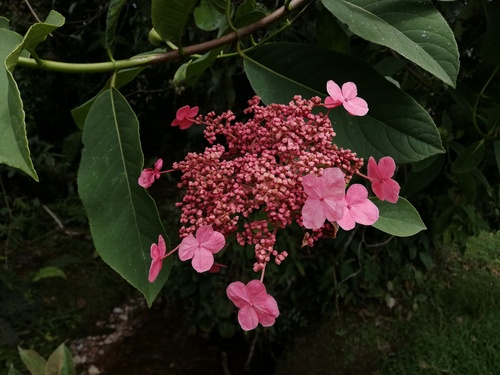
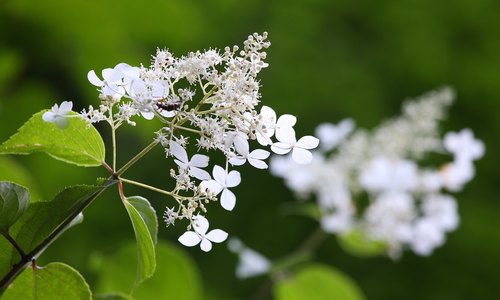
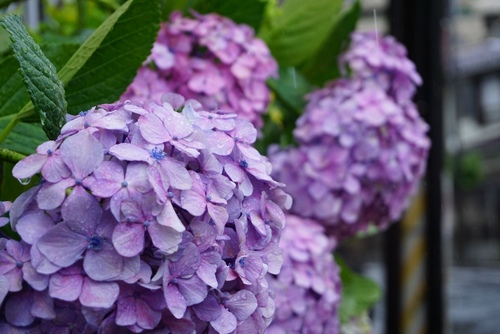
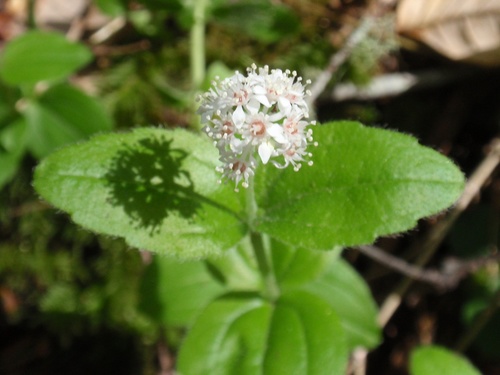
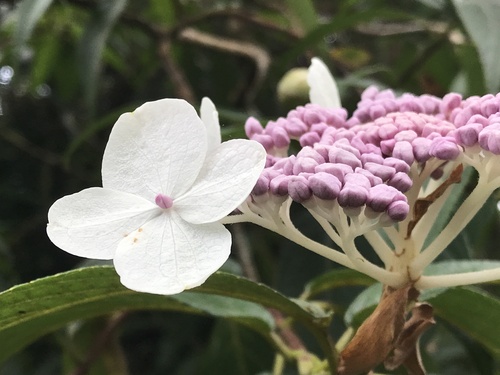
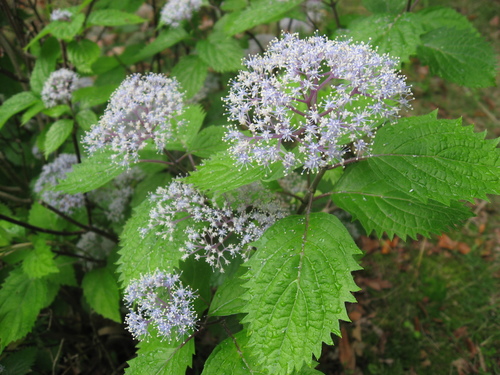
Hydrangea hirta (Thunb.) Siebold is a small deciduous shrub that reaches 0.9 to 1.2 meters (3 to 4 feet) in height. It grows numerous stems from its base, and forms a canopy with a single uniform layer. This species has alternate ovate leaves that end in a pointed tip, measure 5 to 8 centimeters (2.0 to 3.1 inches) long, have deep toothed margins, and are covered in hairs. Leaf yellowing and dropping begins in August. Young branches are hairy, but become glabrous as branches age due to hair loss. Its flowers grow in small clusters, and range in color from light blue to white. Individual flowers are 5 millimeters in diameter, have 5 petals and 10 stamens, and all are fertile. Unlike many other hydrangea species, Hydrangea hirta does not have ornamental bracts. In its flower clusters, a central stem holds a single terminal flower that develops first, while the rest of the flowers develop from terminal buds on lateral stems. Its fruit produces urceolate seeds, which swell in the middle and narrow at the top. This shrub is native to the mountain ranges of Japan, and its distribution extends from the Himalayas through China to Taiwan. In Japan, Hydrangea hirta grows in a belt of montane cool-temperate rainforest. In this belt, it occurs at elevations of 1,200 meters in Kyushu, 1,000–1,800 m (3,300–5,900 ft) in Shikoku, 800–1,650 m (2,600–5,400 ft) in Chūbu, and in the lowlands of southern Hokkaido. One example habitat where this species grows is Tsuga sieboldii forest on the Pacific side of Honshu and Shikoku, where Hydrangea hirta makes up 20–40% of the shrub cover. This slow-growing deciduous species prefers acidic, heavily leached, moist podosolic soils and temperate climates. It is shade tolerant, and grows best in areas with light, partial, or full shade. It is pollinated by bees, and blooms from late spring (June) to early summer. Along with sexual reproduction via pollination, Hydrangea hirta can reproduce vegetatively by forming new plants from buried aerial stems, which eventually break off to grow into new individuals. It can also be propagated from cuttings taken from woody stems, semi-woody stems, and softwood stems. This species is used in horticulture, gardening, and landscaping, and its seeds are available for purchase. Where it has been introduced in European countries, it is notably susceptible to honey fungus. Its cooked leaves have been reported to be edible.