About Hydrangea cinerea Small
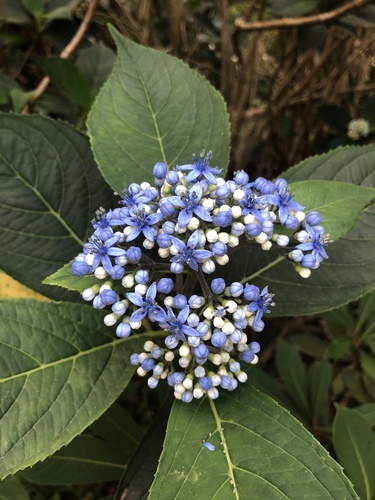
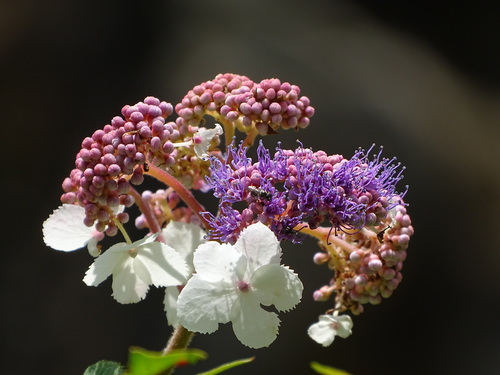
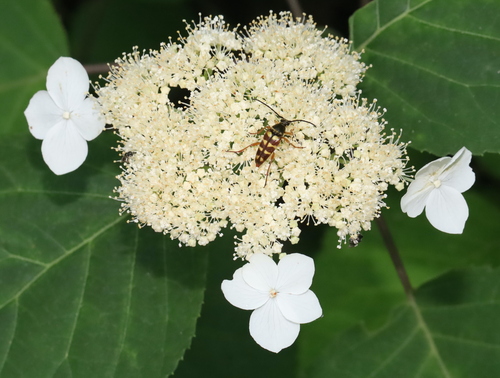
Hydrangea cinerea Small, commonly called ashy hydrangea, bears its inflorescence in the form of a corymb. Only a small number of showy, sterile white to near-white flowers, 0 to 3 per flowerhead, grow around the corymb’s periphery. These sterile flowers are typically more than 1 cm in diameter. This species flowers in late spring or early summer.
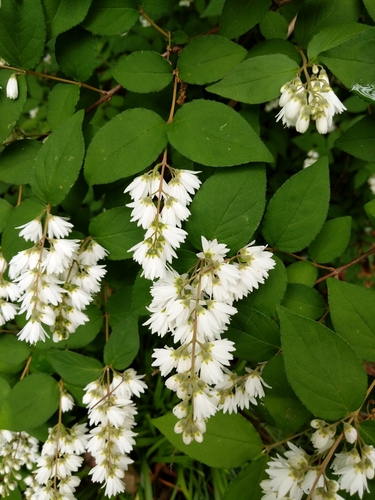
Its leaves are deciduous, opposite, ovate, serrated, and large, measuring 8 to 15 cm (3.1 to 5.9 inches) long. Lower leaf surfaces have variable amounts of pubescence that gives them a gray appearance; the trichomes are usually not dense enough to fully cover the underlying green leaf tissue. When viewed under magnification, the trichomes have distinct, prominent tubercles (bumps).
Ashy hydrangea grows scattered across upland sites and rocky outcrops in interior areas of the southeastern United States. Its range covers the southern Blue Ridge Mountains from Tennessee to South Carolina, extending west to Missouri and south to Arkansas, Alabama, and Georgia. It most often grows in neutral, basic, or calcareous soils.
This attractive native shrub is commonly cultivated as an ornamental plant. It tolerates heat and drought better than silverleaf hydrangea. Several popular cultivars are available, including 'Frosty', 'Pink Pin Cushion', and 'Sterilis', all of which produce a larger proportion of showy sterile flowers.
The Cherokee use this plant for medicinal purposes. An infusion made from scraped bark is taken to induce vomiting of bile. An infusion of the roots is used as a cathartic and emetic by women during menstruation. The Cherokee likely used ashy hydrangea medicinally in the same ways they used smooth hydrangea; later, early European settlers also used it to treat kidney and bladder stones.