About Hydrangea arborescens L.
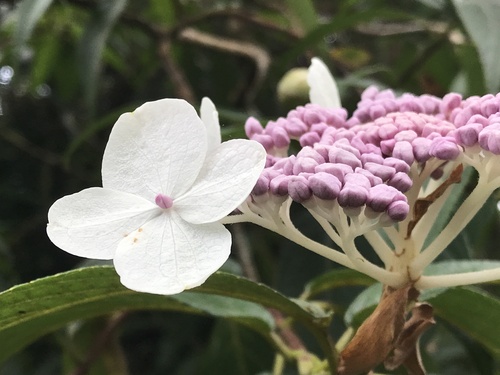
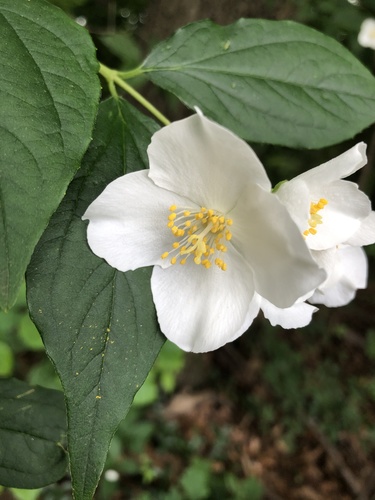
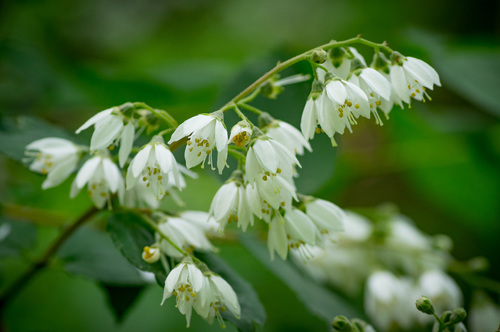
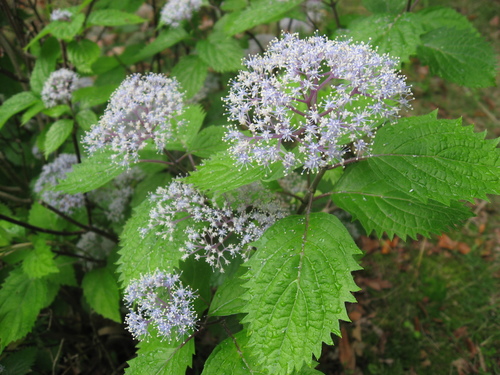
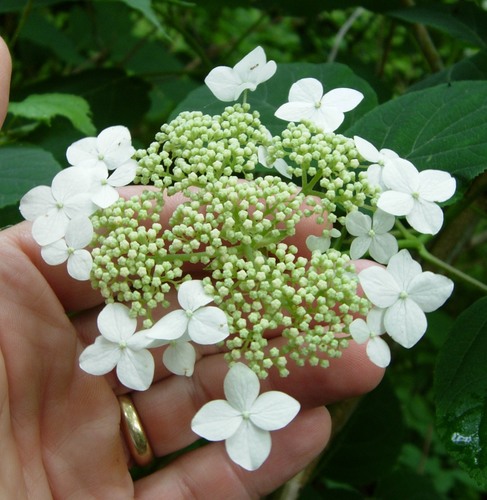
Hydrangea arborescens L., commonly called smooth hydrangea or sevenbark, has an inflorescence that forms a corymb up to 15 centimetres (5.9 in) wide. Showy sterile flowers are usually absent; when present, they typically measure less than 1 cm in diameter and grow along the edges of the panicles. This species flowers from May to July. Its fruit is a ribbed, brown capsule around 2 mm long; many fruits are produced in October and persist through the winter. The leaves are large, measuring 8 to 18 cm long, and are opposite, serrated, ovate, and deciduous. The lower leaf surface is green, either hairless or covered in inconspicuous fine hairs; any trichomes on the lower surface are restricted to the midrib and major veins. The bark of its stems peels off in multiple successive thin layers of differing colors, which is the origin of its common name 'sevenbark'. Smooth hydrangea can spread rapidly via stolons to form dense colonies. This species is widely distributed across the eastern United States, ranging from southern New York to the Florida panhandle, and west as far as eastern Oklahoma and southeastern Kansas. It grows primarily in mesic soils under the canopy of deciduous forests, and is often found along small watercourses and on woodland roadsides. It is especially common in the Delaware River Valley and the Appalachian Mountains. It acts as a host plant for the hydrangea sphinx moth. As an attractive shrub, it is widely cultivated for ornamental purposes. In the United Kingdom, the cultivar 'Annabelle' has received the Royal Horticultural Society's Award of Garden Merit. The cultivar 'Grandiflora' produces inflorescences that resemble snowballs, similar to those of Viburnum opulus 'Roseum'. The root of smooth hydrangea was used medicinally by the Cherokee people, and later by early European settlers, to treat kidney and bladder stones. It is also classified as a pollinator plant that supports and attracts both bees and butterflies.