About Hydrangea anomala D.Don
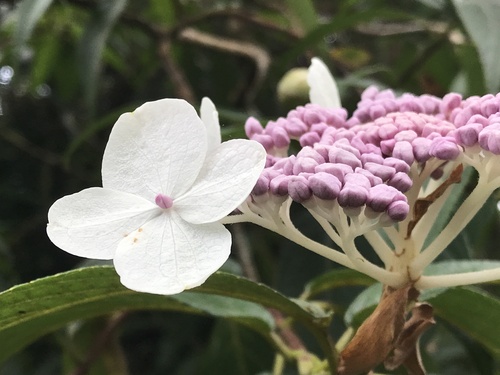
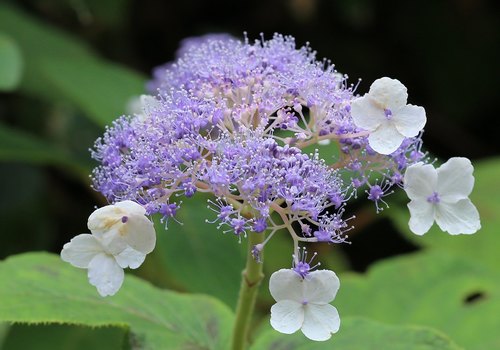
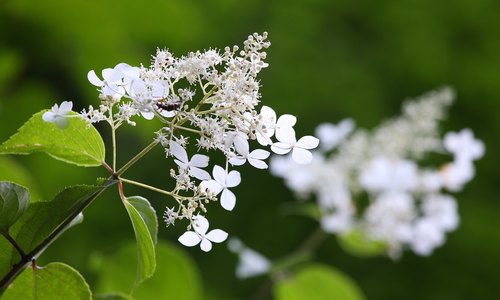
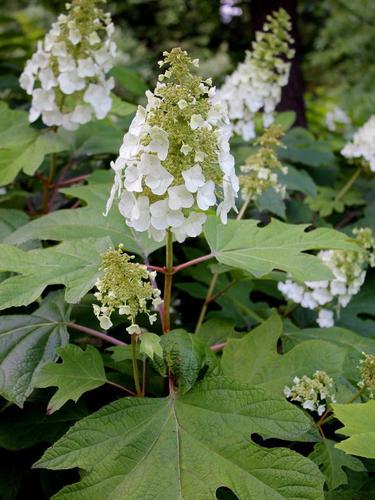
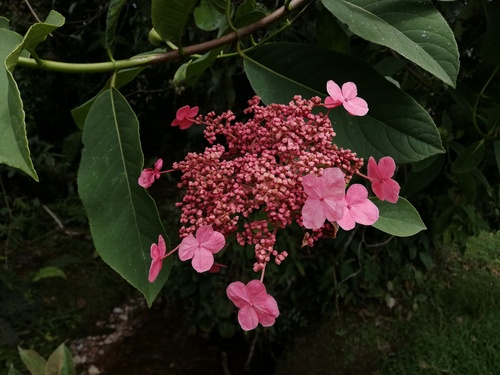
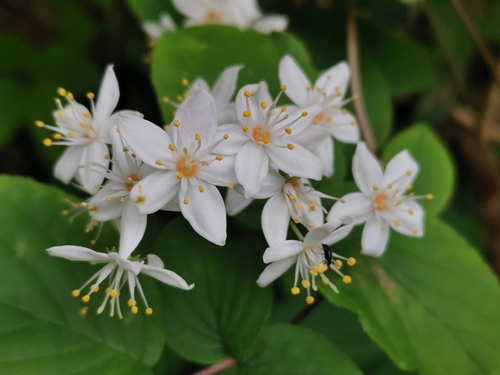
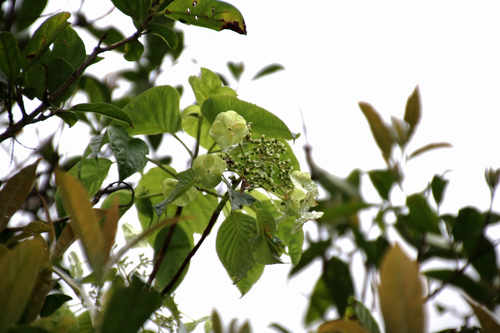
Hydrangea anomala, commonly called Japanese climbing-hydrangea, is a flowering plant species in the family Hydrangeaceae. It is native to woodlands in the Himalaya, southern and central China, and northern Myanmar. It is a woody climbing plant that reaches heights of 12 m (39 ft) when growing up trees or rock faces, climbing with small aerial roots on its stems. Its leaves are deciduous and ovate, measuring 7–13 cm (2.8–5.1 in) long and 4–10 cm (1.6–3.9 in) broad, with a heart-shaped base, coarsely serrated margin, and acute apex. In mid-summer, it produces flowers arranged in flat corymbs 5–15 cm (2.0–5.9 in) in diameter. Each corymb holds a small number of peripheral sterile white flowers 2–3.5 cm (0.8–1.4 in) across, along with many small, creamy-white fertile flowers only 1–2 mm in diameter. Its fruit is a dry, urn-shaped capsule 3–5 mm in diameter that contains several small winged seeds. Hydrangea petiolaris, a closely related species native to eastern Siberia, Japan, and Korea, is sometimes classified as a subspecies of Hydrangea anomala. It differs from H. anomala by growing larger, reaching up to 20 m (66 ft) in height, and producing flower corymbs up to 25 cm (9.8 in) in diameter. The common name climbing hydrangea is used for both species. Hydrangea anomala is cultivated as an ornamental plant. Its subspecies H. anomala subsp. petiolaris has been awarded the Royal Horticultural Society's Award of Garden Merit.