About Hydractinia echinata (Fleming, 1828)
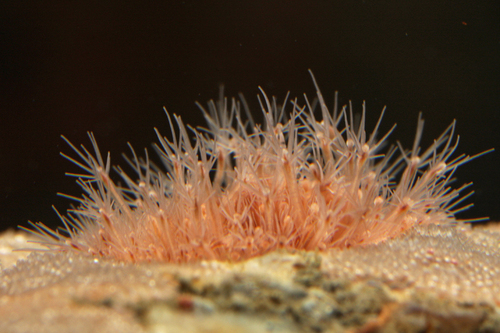
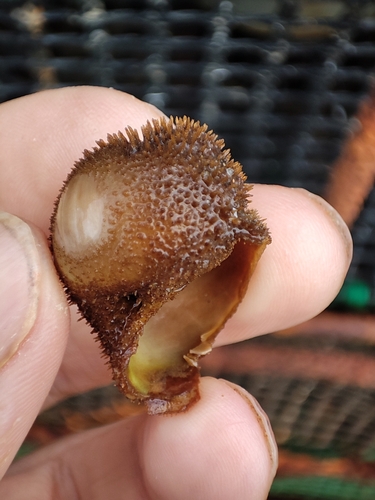
Hydractinia echinata forms pinkish-brown patches when alive, or plain brown patches when dead, on gastropod shells occupied by hermit crabs. These patches most often grow near the shell’s aperture. The horny mat, also called the hydrorhiza, is roughly three millimetres thick, and is made of thick jagged spines that can reach three millimetres in height. Three distinct types of polyps grow among these spines. Club-shaped feeding polyps can grow up to thirteen millimetres long, with two rows of eight tentacles each; the lower row of tentacles is shorter than the upper row. Separate male and female reproductive polyps, called gonozoids, bear a small number of short tentacles at their tip. Scattered among the other polyps are specialized defensive stinging polyps called dactylozooids, which take the form of long, coiled threads. Mature gonozoids release crawling planula larvae that search out new moving gastropod shells to settle on. H. echinata occurs on all coasts surrounding the northern Atlantic Ocean, including the Arctic Ocean, Gulf of Saint Lawrence, Baltic Sea, and North Sea. Its range extends south along the eastern Atlantic to northwest Africa, and across the Western Atlantic to include the Gulf of Mexico. It is common around the coasts of Britain and Ireland, where it occurs in areas that host the hermit crab Eupagurus bernhardus, on the lower shore in sandy substrates.