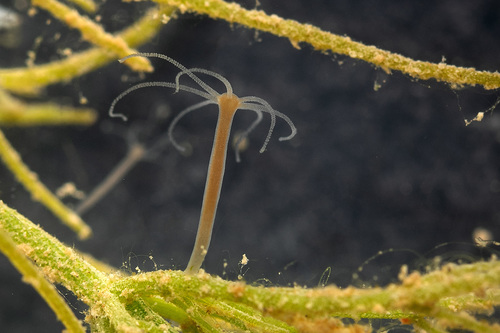
About Hydra viridissima Pallas, 1766
Hydra viridissima Pallas, 1766 is a species of cnidarian commonly found in still or slow-moving freshwater across the Northern temperate zone. It is most often called green hydra, a name that comes from its green coloration, which is produced by symbiotic Chlorella vulgaris green algae that live inside its body. Recent genomic research has found that Hydra viridissima suppresses parts of its innate immune system to let its symbiotic Chlorella algae survive inside its cells. This adaptation gives researchers useful insight into the evolution of intracellular symbiosis in early metazoans. Mature individuals of this species are typically around 10 mm long, with tentacles that measure roughly half their total body length. They are strictly carnivorous, and most commonly feed on small crustaceans, insects, and annelids. Like other hydras, they are normally sessile, and live attached to aquatic vegetation. They use their basal disc to secrete mucus that anchors them to their substrate. The broader term "green hydra" also refers to a specific clade that includes H. viridissima and other closely related photosymbiotic hydra species. This clade contains at least four confirmed species: H. viridissima, H. hadleyi, H. plagiodesmica, and H. sinensis. Like other hydras, H. viridissima individuals are typically either hermaphroditic or gonochoric. Unlike many other related cnidarians, hydras completely lack a medusa life stage, and only the polyp stage reproduces both sexually and asexually. H. viridissima engages in sexual reproduction when water temperatures warm to at least 20 °C, which usually occurs between May and June. Larger individuals develop both ovaries and testes, while smaller individuals only produce testes. For this species, sexual reproduction acts as a survival strategy for periods of low nutrients or other unfavorable environmental conditions. H. viridissima has three distinct sexual categories: female, male, and hermaphrodite. Simultaneous hermaphrodites are the most common group during the growing season. Researchers believe female gonads require a longer period of inductive conditions to develop, which leads to a scarcity of females in most H. viridissima populations. During summer months, Lemna blooms in Poland reduce light penetration through the water, which lowers the photosynthesis efficiency of the symbiotic Chlorella algae living in the hydras, and this change affects the species' asexual reproductive behavior. Even though all individuals become sexually active at the start of the mating season, asexual reproduction remains the species' primary reproductive strategy overall. This alternating pattern of asexual and sexual reproduction allows H. viridissima populations to continue growing across a wide range of environmental conditions. When H. viridissima reproduces asexually, it produces new buds that grow out from the parent's body wall. These buds are genetically identical clones of the parent individual. Once the buds reach full maturity, they break free from the parent. A single parent can host multiple buds at the same time, each at a different stage of development. After detaching from the parent, the new individual floats through the water until it finds a hard substrate to attach to.