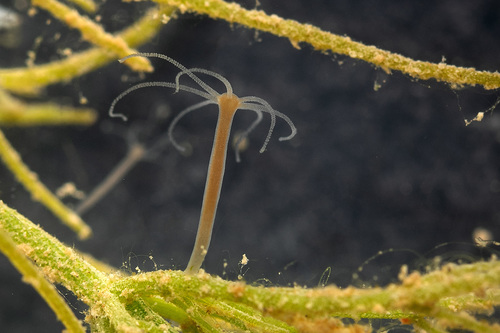
About Hydra oligactis Pallas, 1766
Hydra oligactis Pallas, 1766, commonly called the brown hydra, is a species of hydra. It is widely dispersed across the northern temperate zone, and also occurs in the Southern Hemisphere. It is a common organism that inhabits still waters from early spring through late autumn. The term "brown hydra" can also refer to a clade within the genus Hydra, grouped in opposition to the "green hydra" clade. This hydra is commonly found attached to aquatic plant stems, leaf undersides, submerged twigs, and stone surfaces. When disturbed, it retracts into a small, easily overlooked brown blob. Gently sweeping through a clean, weed-containing pond, then letting the collected water and plant leaves sit in a jar, will often allow this hydra to emerge within just a few minutes. When in feeding mode, its fully extended tentacles are very long, and can be longer than 1 inch (25 mm). In this extended state, the tentacles are hard to see with the naked eye, and are usually only visible after the hydra catches prey such as Daphnia. Several features distinguish Hydra oligactis from other brown hydra species in cool temperate waters: the relative length of its tentacles compared to its body, the asymmetrical emergence of tentacles during budding, and characteristics of the cnidocytes found on its tentacles. This species is preyed on by the flatworm Microstomum lineare, which incorporates Hydra stenoteles into its own epidermis.


