About Hydnum repandum L.
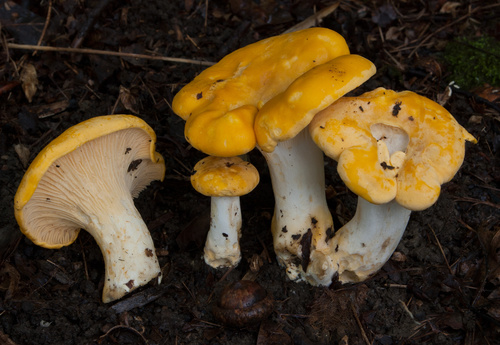
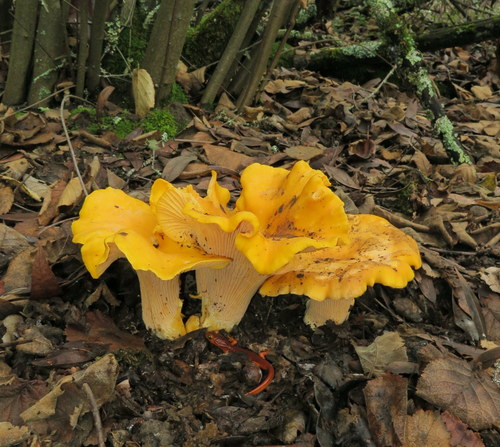
Hydnum repandum L., commonly known as the hedgehog fungus, has a cap (pileus) that ranges in color from orange, yellow, to tan. The cap is typically up to 17 centimetres (6+1⁄2 in) wide, though specimens as large as 25 cm (10 in) have been recorded. It is generally somewhat irregular in shape; at maturity it can be convex or concave, with a wavy margin that is rolled inward when young. When multiple fruit bodies grow close together, their caps develop distorted shapes. The cap surface is usually dry and smooth, but mature specimens may develop cracking. Viewed from above, the caps of mature H. repandum somewhat resemble the caps of chanterelles.
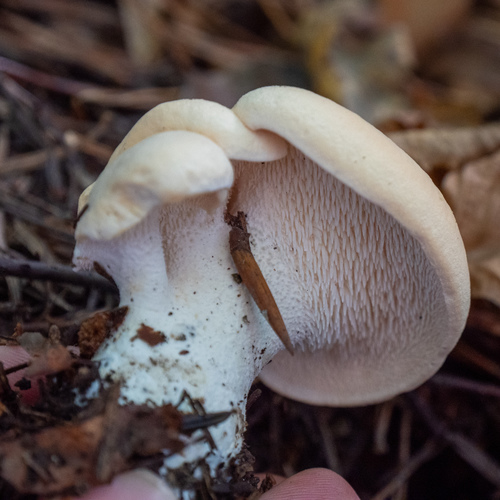
The flesh of Hydnum repandum is thick, white, firm, and brittle, and turns yellow to orange-brown when bruised. The underside of the cap is densely covered with small, slender whitish spines that measure 2–7 mm (1⁄16–1⁄4 in) long. These spines sometimes extend down at least one side of the stipe (stem). The stipe is typically 3–10 cm (1–4 in) long and 1–3 cm (1⁄2–1+1⁄4 in) thick; it is either white or matches the cap's color, and is sometimes positioned off-center. These mushrooms are easy to overlook when growing among gilled mushrooms and boletes: their cap and stipe are fairly nondescript, and their characteristic spines can only be seen by turning the mushroom over.
A pure white variety of this species, H. repandum var. album, is smaller than the main variety. Its cap is 2–7 cm (1–3 in) wide, and its stipe is 1–3 cm (1⁄2–1+1⁄4 in) long.
Microscopically, the spore print of H. repandum is pale cream. Basidiospores are smooth, thin-walled, hyaline (translucent), roughly spherical to broadly egg-shaped, and measure 5.5–7.5 by 4.5–5.5 μm. Most spores contain a single large refractive oil droplet. The spore-bearing basidia are club-shaped, four-spored, and measure 30–45 by 6–10 μm. The cap cuticle is a trichodermium: outermost hyphae emerge roughly parallel, like hairs, perpendicular to the cap surface, and consist of narrow, club-shaped cells 2.5–4 μm wide. Beneath this cuticle is a subhymenial layer of interwoven hyphae 10–20 μm in diameter. Spine tissue is made of narrow (2–5 μm diameter), thin-walled hyphae that have clamp connections.
Hydnum repandum is a mycorrhizal fungus. Its fruit bodies grow singly, scattered, or in groups on the ground or in leaf litter in both coniferous and deciduous forests, and can also grow in fairy rings. Fruiting occurs from summer to autumn. It is one of the most common tooth fungi. The species is widely distributed in Europe, where it has been listed as a vulnerable species in the Red Data Lists of the Netherlands, Belgium, and Germany; Sweden lists it as Least Concern. In North America, the species is found in the Pacific Northwest, the Rocky Mountains, and growing with oaks in eastern North America. It does not occur in Canada, though two related species — H. washingtonianum and H. subolympicum — are found there.