About Hydnum oregonense Norvell, Liimat. & Niskanen
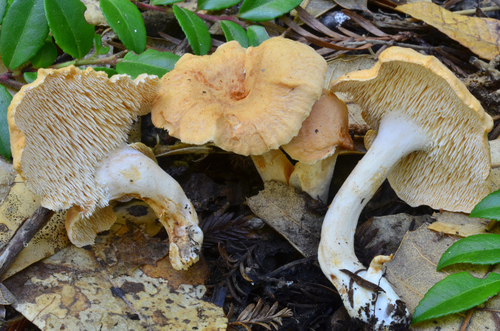
Hydnum oregonense is a species of tooth fungus that belongs to the family Hydnaceae. It was first formally scientifically described in 2018 by Norvell, Liimatainen and Niskanen. The cap of the fungus ranges from 1.5 to 4 centimetres (1⁄2 to 1+1⁄2 inches) wide, and is colored tan to orange, with whitish patches. The spines (teeth) on the underside of the cap are 2 to 6 millimetres (1⁄8 to 1⁄4 inch) long. The stem measures 2 to 5 centimetres (3⁄4 to 2 inches) long and 5 to 10 millimetres (1⁄4 to 3⁄8 inch) thick. The flesh of Hydnum oregonense is whitish, and it produces a white spore print. Some other species in the Hydnum genus are more robust than this species and do not have central navel indentations. Other known lookalikes include Mycorphapium adustum, and species from the genera Hydnellum and Phellodon. This fungus is found near the west coast of North America, where it grows from November to March under conifer and tan oak trees. It is edible.