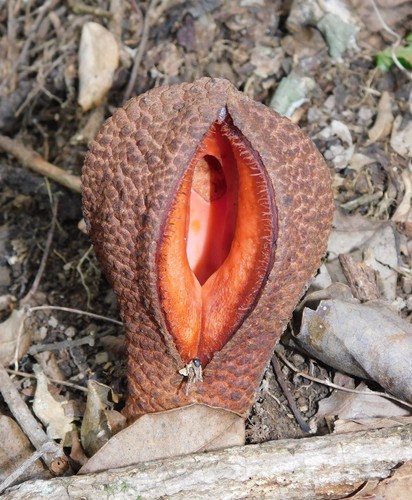
About Hydnora africana Thunb.
Hydnora africana Thunb. is a non-photosynthetic parasitic plant that lacks chlorophyll, and its vegetative structures look more like fungi than typical plants. It gets all of its nutrients from a host plant, most commonly a species of Euphorbia. It is made up of thick, succulent roots with no stems, and its flowers develop on the surface of its host’s roots. To attach to its host, H. africana produces an enzyme that lets it dissolve part of the host’s roots, then connects to the host roots to take nutrients the host produced via photosynthesis. Its flowers have a thick, succulent texture. The above-ground portion of the flower is tubular with three openings, and it has three botanical structures called perianth segments, which are comparable to sepals, that join at the top of the flower. This fleshy peachy-orange flower emerges from the ground after heavy rainfall. A short tube forms where the perianth segments meet. Inside the front part of the tube, yellowish-orange structures extend into the tube: these are grouped anthers, held in bunches to act as the flower’s stamens. The anther groups are arranged in a triangle, which creates gaps that let visiting beetles fall down onto the parasitic plant’s stigma. The base of the flower holds a cavity that contains white ovules, which mature into seeds. Pollinating insects enter the flower through strong fibers that hold the perianth segments (sepals) together. After the insects have stayed inside the flower for a couple of days, the flower opens completely to release them, so they can carry pollen to other H. africana flowers. The flower gives off a rotting odor that attracts dung beetles and other insects. Once inside, the insects become trapped by stiff bristles on the flower walls. Trapped insects fall down the flower tube onto the anthers, where pollen sticks to their bodies, then continue falling further down onto the stigma. For reproductive observation, H. africana seeds collected from Africa were planted in pots with Euphorbia hosts in the United States, and the first flower appeared five and a half years after sowing. H. africana can be harvested for use as food, medicine, and it is a good source of tannin. In South Africa, rhizome extracts from the plant are used to treat dysentery.

