About Hydnophora rigida (Dana, 1846)
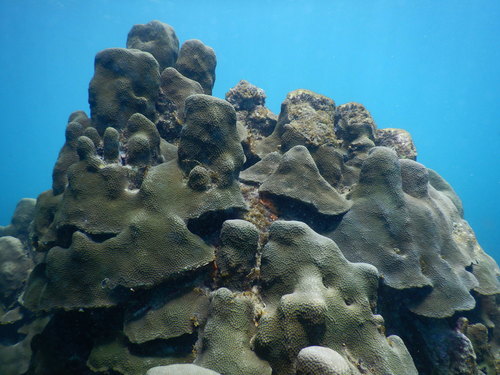
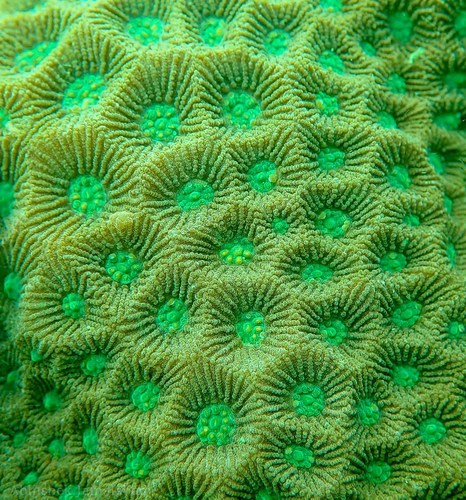
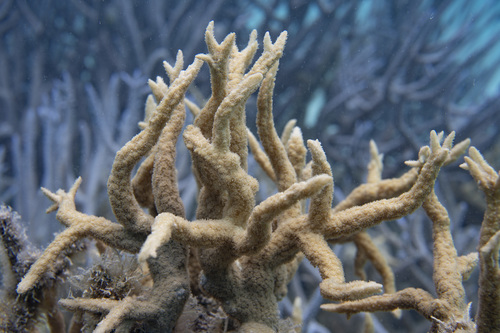
Hydnophora rigida, commonly called horn coral or spine coral, is one of the most common species in the Hydnophora genus. It forms bushy colonies with thin, cream or green branches that lack encrusting bases. Unique small conical projections called monticules form on this coral where the corallite walls of adjacent polyps fuse together. Polyps surrounding the base of monticules often appear brown, creating a slight contrast with other tissue. H. rigida exhibits green fluorescence or cyano red emission, and its polyps extend tentacles at night. Colonies grow at depths between 1 and 30 meters (3 to 100 feet). It is most commonly found in shallow reef habitats, particularly in lagoons and protected reef slopes. Its confirmed distribution includes reef environments around Australia, including the Great Barrier Reef, North West Cape, the Coral Sea, and the Houtman Abrolhos Islands, as well as the Philippines, Fiji, Indonesia, Samoa, the Solomon Islands, the east coasts of Africa, and Madagascar. H. rigida was first formally described by James Dwight Dana in 1846. This coral is a simultaneous hermaphrodite and a broadcast spawner, meaning it releases eggs rather than retaining developed planula larvae. Its eggs are relatively small, measuring approximately 220 μm. H. rigida develops eggs earlier than it develops testes. Multiple lines of evidence indicate that most colonies undergo multiple gametogenic cycles each year, unlike many coral species that only spawn once annually. Colonies typically spawn after the full moon in November, and populations remain fertile from November through February, suggesting the spawning season can extend over several months. In the Houtman Abrolhos Islands, colonies carry ripe eggs in March, leading to the inference that they participate in Western Australia's annual mass spawning event. This has led researchers to speculate that H. rigida follows a biannual spawning cycle, with non-overlapping spawning events in November and March. Researchers have observed that most colonies contain ripe eggs before the November full moon, and ripe testes around the November full moon, with far fewer fertile colonies present in December, consistent with this spawning pattern. After fertilization, developing eggs become planula larvae that settle onto substrates, where they attach and develop into tiny polyps. These polyps excrete calcium carbonate and slowly grow into mature coral colonies.