About Hydnellum scrobiculatum (Fr.) P.Karst.
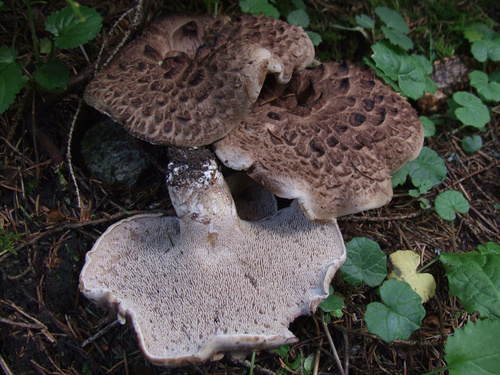
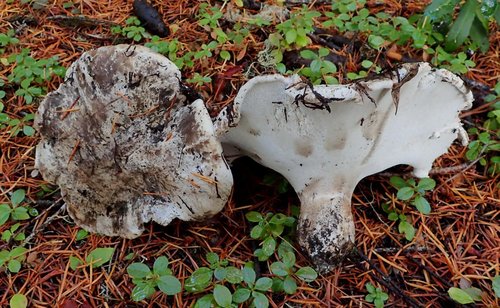
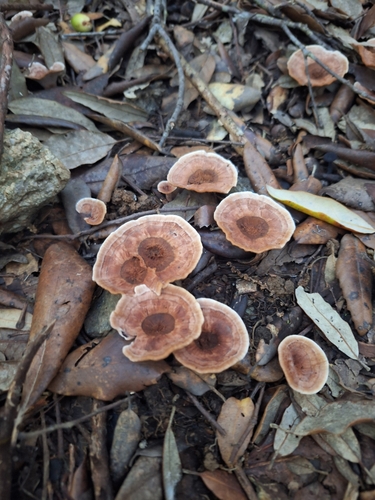
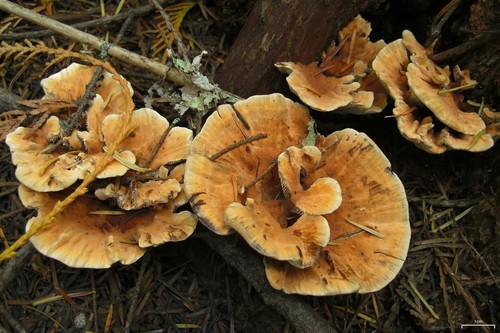
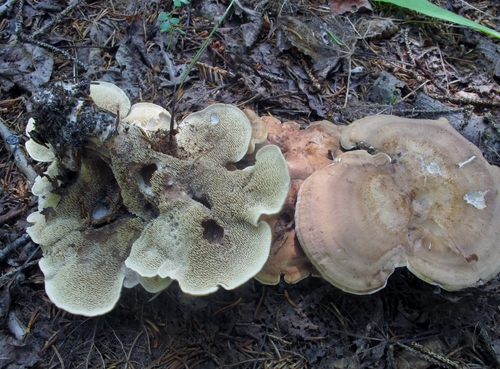
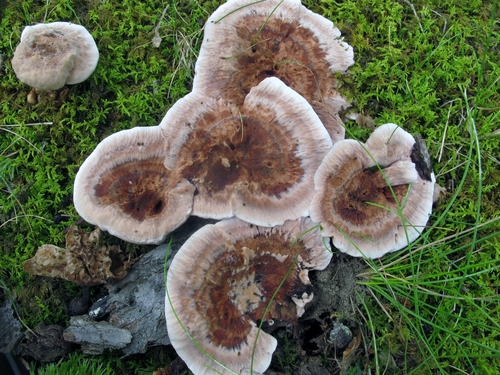
Hydnellum scrobiculatum (Fr.) P.Karst. produces fruitbodies with centrally depressed caps that measure 2–6 cm (0.8–2.4 in) in diameter. Individual caps can fuse together to form larger concrescent fruitbodies. Caps have wavy edges; their surface is initially felty, and becomes scaly as the fungus ages. Young fruitbodies are white, changing color to pinkish-brown, then to purplish brown as they mature, and sometimes retain white margins. Older fruitbodies can develop a shiny surface. The spines growing on the underside of the cap reach up to 4 mm in length. They are initially white, turning purplish brown when mature, and are decurrent, meaning they run down the length of the stipe. The stipe is roughly the same color as the cap, and measures 2–3 cm (0.8–1.2 in) long by 1–1.5 cm (0.4–0.6 in) thick. Mycelium growing at the base of the stipe envelops and grows around surrounding forest litter. The flesh has a mealy odor, similar to freshly ground flour. The edibility of this species was previously unknown, but Roger Phillips has rated it as "poor". In general, all Hydnellum species are too acrid and woody to be considered palatable. Like all members of the genus Hydnellum, H. scrobiculatum produces a brown spore print. Individual spores are more or less spherical in shape, with dimensions of 5.5–6.5 by 4–5.6 μm, and have wart-like tubercle projections on their surface. The spore-bearing basidia are narrowly club-shaped, four-spored, and measure 23–29 by 5–6.5 μm. This fungus fruits singly, in clusters, or in fused groups in coniferous and mixed forests. It is distributed across Europe, Asia, and North America. In the United Kingdom, it is classified as vulnerable under the biodiversity action plan for stiped hydnoid fungi.