About Hydnellum peckii Banker
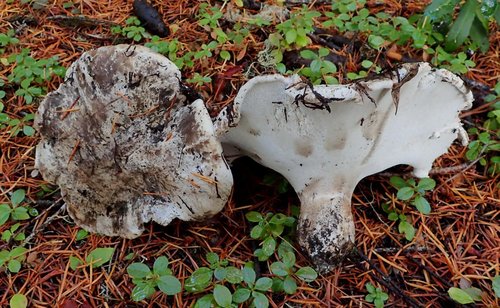
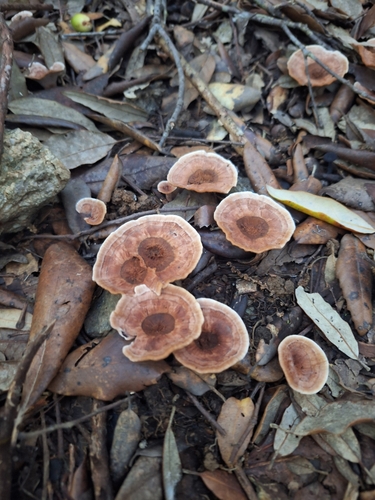
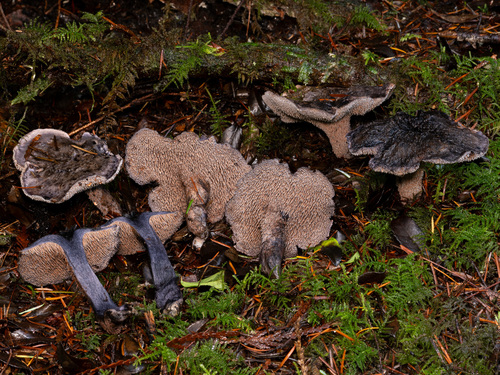
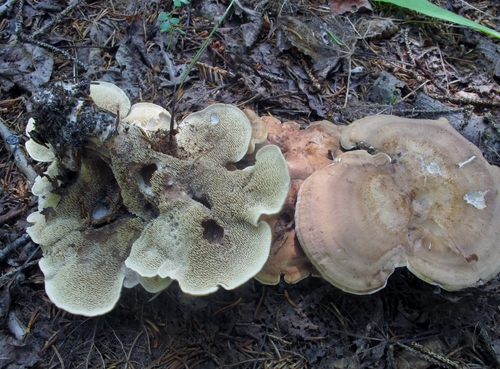
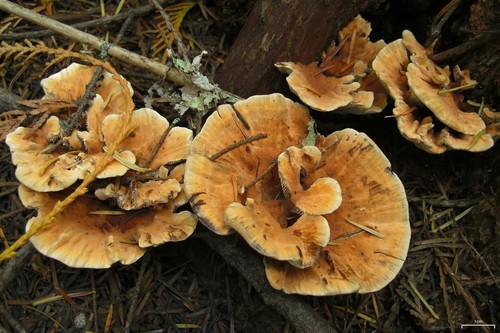
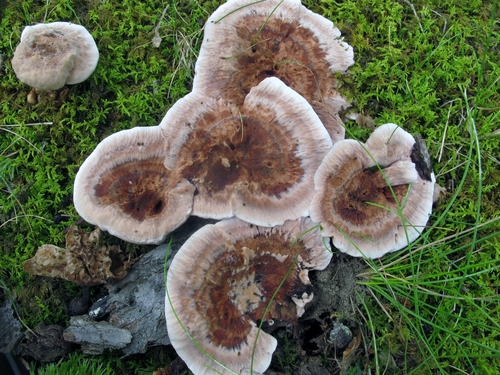
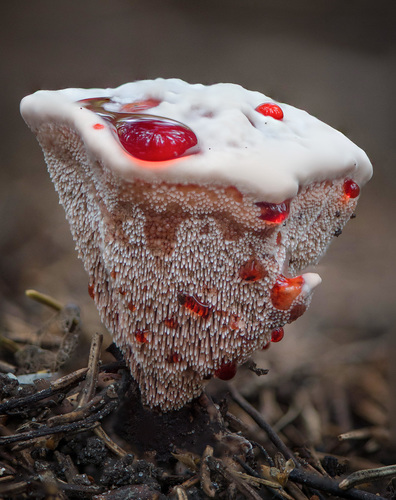
Like all mushroom-producing fungi, Hydnellum peckii produces fruit bodies (reproductive sporocarps) from fungal mycelium when environmental conditions of temperature, humidity, and nutrient availability are suitable. It is a stipitate hydnoid fungus, meaning it has a cap growing on top of a stem (called a stipe), a form similar to Hydnum, and its hymenium is made of tooth-like structures rather than gills or pores on the underside of its cap. Fruit bodies growing close together often fuse together, a trait called confluence. They can grow up to 10.5 cm (4+1⁄8 in) tall. When moist, fresh fruit bodies exude a distinct thick red fluid, even when young; young specimens have a lumpy appearance. The cap surface ranges from convex to flattened, is more or less uneven, and is sometimes slightly depressed at its center. It is usually densely covered with small "hairs" that create a felt or velvet-like texture; these hairs wear away with age, leaving mature caps smooth. Cap shape ranges from somewhat round to irregular, measuring 4 to 10 cm (1+5⁄8 to 3+7⁄8 in) across, and can reach up to 20 cm (7+7⁄8 in) wide when multiple caps fuse. Young caps are initially whitish, and later turn slightly brownish, developing irregular dark brown to nearly black blotches in bruised areas. When mature, the cap surface is fibrous, tough, scaly, and jagged, with a grayish-brown color on its upper portion and a somewhat woody texture. The flesh is pale pinkish brown, and its spore print is brown. The spines (tooth-like hymenial structures) are slender, cylindrical, tapering (terete), less than 5 mm (1⁄4 in) long, and become shorter closer to the cap edge. They are crowded tightly together, with typically 3 to 5 teeth per square millimeter. Initially pinkish white, they turn grayish brown as they age. The stem is thick, very short, and often deformed. It becomes bulbous where it enters the ground, and can root several centimeters into the soil. While its total length can reach up to 5 cm (2 in), and it measures 1 to 3 cm (3⁄8 to 1+1⁄8 in) wide, only 0.1 to 1 cm (1⁄16 to 3⁄8 in) of the stem appears above ground. The upper part of the stem is covered in the same teeth found on the underside of the cap, while the lower portion is hairy and often holds debris from the forest floor. The odor of the fruit body is described as "mild to disagreeable", or, as original describer Banker noted, similar to hickory nuts. Fruit bodies of Hydnellum peckii grow solitary, scattered, or clustered on the ground under conifers, often among mosses and pine needle litter. It is a late-stage fungus; in boreal forests dominated by jack pine, it typically associates with more mature host trees after the forest canopy has closed. It shows a preference for mountainous or subalpine ecosystems. This fungus has a wide distribution across North America, and is especially common in the Pacific Northwest; its range extends north to Alaska and east to North Carolina. In the Puget Sound area of the U.S. state of Washington, it grows in association with Douglas-fir, fir, and hemlock. Along the Oregon Coast, it has been collected growing under lodgepole pine. In addition to North America, the mushroom is widespread in Europe, and its presence has been documented in Italy, Germany, and Scotland. It is common in Scotland, but has become increasingly rare in several other European countries, including Norway, the Netherlands, and the Czech Republic. Increased pollution in central Europe has been proposed as one possible cause of the species' decline there. Reports from Iran in 2008 and Korea in 2010 marked the first records of the species outside Europe and North America. Hydnellum peckii is a mycorrhizal fungus, meaning it forms a mutualistic relationship with the roots of certain host trees. In this relationship, the fungus exchanges minerals and amino acids it extracts from soil for fixed carbon produced by the host via photosynthesis. The fungus's subterranean hyphae grow a tissue sheath around the rootlets of a broad range of tree species, forming an ectomycorrhizal association that is particularly beneficial to the host: the fungus produces enzymes that mineralize organic compounds and makes nutrient transfer to the tree easier. It forms ectomycorrhizal associations primarily with conifer species such as Picea abies and Pinus sylvestris, exchanging soil nutrients for photosynthetically derived carbon from its host trees. Field studies show it prefers acidic, moss-covered soils, and can act as a bioindicator of undisturbed old-growth forest ecosystems. The ectomycorrhizal structures of H. peckii are among the few in the Bankeraceae family that have been studied in detail. They are characterized by a plectenchymatous mantle: a tissue layer made of hyphae tightly arranged in a parallel orientation (palisade), which rarely branch or overlap one another. These hyphae, along with any adhered mineral soil particles, are embedded in a gelatinous matrix. The hyphae of the ectomycorrhizae can develop into chlamydospores, an adaptation that helps the fungus tolerate unfavorable conditions. H. peckii's chlamydospores have a unique structure that sets them apart from those of other Bankeraceae: they have thick, smooth inner walls, and an outer wall that is split radially into warts. The most notable characteristic of the whole ectomycorrhizae is that older sections shed their black outer layers, giving a "carbonized appearance". Most of the fungus's underground biomass is concentrated near the soil surface, most likely in mycelial mats—dense clusters of ectomycorrhizae and mycelium. The fungus's mycelium can also extend far from the location of its fruit bodies, up to 337 cm (11 ft) away. Molecular techniques have been developed to support conservation efforts for stipitate hydnoid fungi, including H. peckii. Traditionally, the species' distribution was determined by counting visible fruit bodies, but this method has a major drawback: fruit bodies are not produced consistently every year, so an absence of fruit bodies does not mean the fungus's mycelium is absent from the soil. More modern techniques that use the polymerase chain reaction to detect fungal DNA in soil help resolve issues with monitoring the presence and distribution of the fungus's mycelia. Hydnellum peckii fruit bodies have been described as resembling "Danish pastry topped with strawberry jam". While Hydnellum species are not known to be poisonous, they are not considered particularly edible due to their unpleasant acrid taste, which remains even after the fruit bodies are dried. The fruit bodies of this species and other Hydnellum species are valued by mushroom dyers. They can produce colors ranging from beige (when no mordant is used) to various shades of blue or green, depending on the mordant added.