About Hydnellum ferrugineum (Fr.) P.Karst.
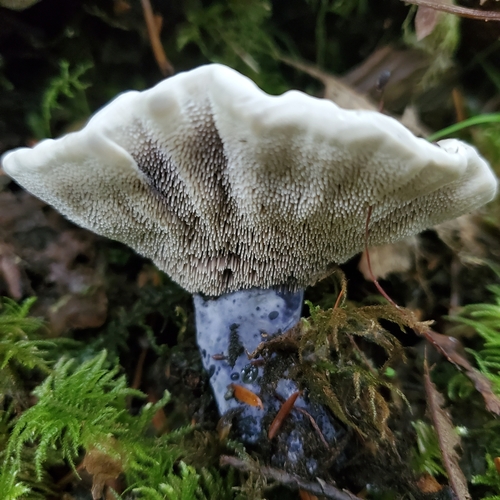
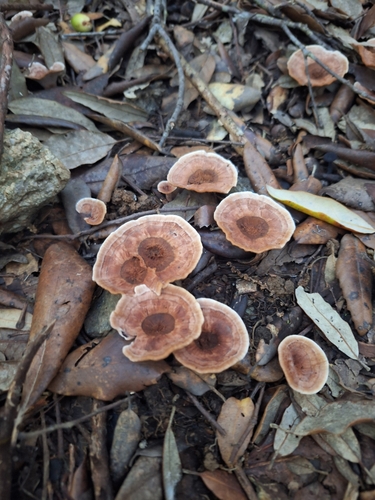
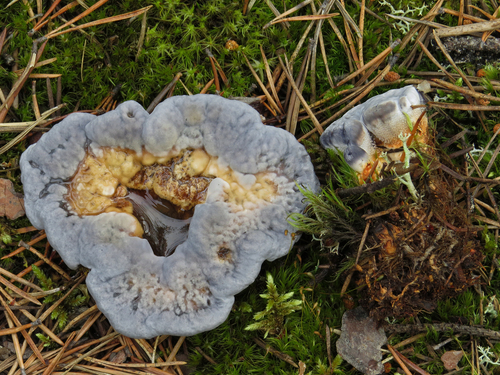
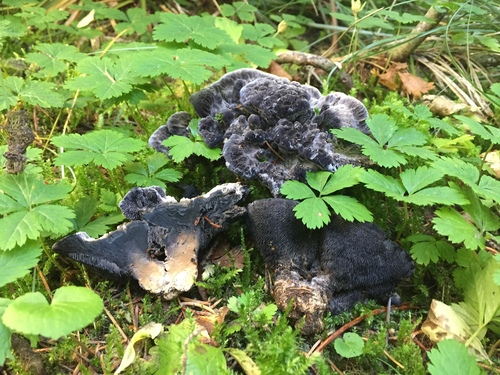
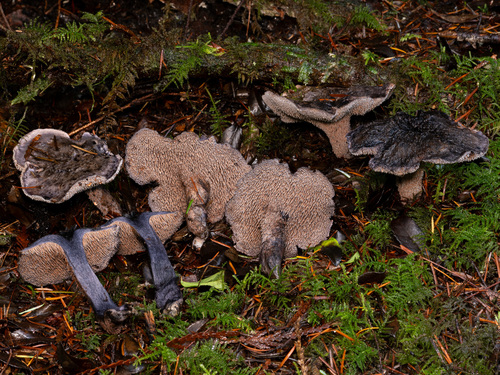
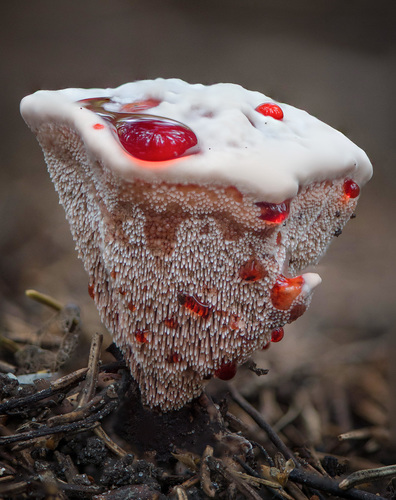
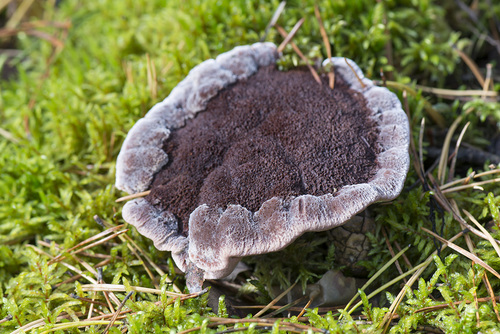
Hydnellum ferrugineum (Fr.) P.Karst. produces fruit bodies that are roughly top-shaped, with caps 3–10 cm (1.2–3.9 in) in diameter. Young caps are first convex, then become cushion-shaped (pulvinate), and eventually flatten or develop a slight depression at the center. The cap surface of young fruit bodies is uneven, with a velvety to felted texture, and ranges in color from whitish to pink. It sometimes releases blood-red drops of fluid into its surface depressions. As the fruit body matures, the cap surface changes to flesh-colored or dark reddish brown, though its wavy margin remains whitish. The lower surface of the fruit body holds the hymenium, the fertile spore-bearing tissue, which is made up of a dense layer of vertically hanging spines up to 6 mm long, colored white to reddish brown. The stout stipe is 1–6 cm (0.4–2.4 in) long by 1–3 cm (0.4–1.2 in) thick, and matches the cap in color. Fruit bodies have a distinctly mealy odor, similar to the scent of freshly ground flour, and are inedible. The flesh is reddish or purplish-brown with white flecks. It starts out spongy and soft, and becomes tough and corky as the fruit body matures; in older stipes, the flesh can turn blackish. Like other species in the Hydnellum genus, fruit body tissue is composed of generative hyphae that do not expand. This slows fruit body growth, often allowing the structure to persist for several months. The fungus follows an indeterminate growth pattern: fruit body development begins from a vertical column of hyphae, which eventually expands at the top to form the cap. Any solid objects such as grass or twigs encountered during growth can become enveloped by the expanding fruit body, and closely neighboring caps may fuse together during growth. The spores of Hydnellum ferrugineum are broadly ellipsoid to roughly spherical, measuring 5.5–7.5 by 4.5–5.5 μm, with surfaces covered in small rounded bumps. The spore-bearing basidia are narrowly club-shaped, four-spored, and measure 25–30 by 6–7.5 μm. Flesh hyphae are brownish with thin walls, measuring 4–6 μm; hyphae in the spines are thin-walled, septate, sometimes branched, and measure 3.5–4.5 μm. None of the hyphae have clamp connections. Hydnellum ferrugineum grows mainly in coniferous woodland, often near pines, and occasionally near spruce. Its fruit bodies prefer sandy soil with low organic matter and nutrient levels, and grow singly or in clusters. They are most commonly found in older-growth forests. This fungus occurs in North America, including Mexico. It is widespread but generally uncommon across Europe, though it may be common in some local areas. In Britain, H. ferrugineum is provisionally classified as endangered, and is protected under the Wildlife and Countryside Act 1981; in 2004, it was included as one of 14 species addressed in the United Kingdom Biodiversity Action Plan for stipitate hydnoid fungi (hydnoid fungi with a distinct cap and stipe). The fungus is also protected in Montenegro, and has been collected in India and North Africa. The fungus forms a tough mat of mycelia in the humus and upper soil of pine forests. This mycelial mat grows larger alongside old trees, and can cover an area of several square meters. These mats generally lack dwarf shrubs, promote vigorous moss growth, and often host reindeer lichens in the center of large mats. The presence of the fungus alters soil properties: it produces a thinner humus layer, decreases groundwater penetration, lowers soil pH, increases root respiration level and root quantity, and reduces organic carbon and nitrogen concentrations. Soil containing the fungus's mycelium becomes more podzolized than the surrounding surrounding soil. Like some other Hydnellum species, H. ferrugineum is sensitive to increased nitrogen deposition from the forestry practice of clear-cutting, which is used in some regions of Europe. It forms an unusual type of mycorrhiza with Scots pine (Pinus sylvestris): the ectomycorrhiza appears normal at the leading edge of the mycelial mat, but leaves dead, atrophied roots at the trailing edge, showing saprophytic tendencies.