About Hydnellum caeruleum (Hornem.) P.Karst.
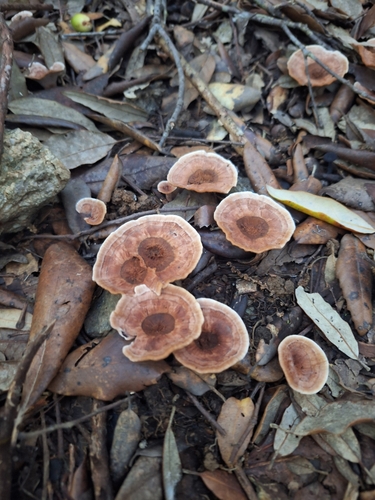
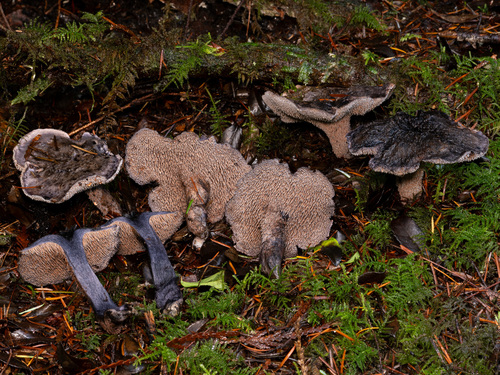
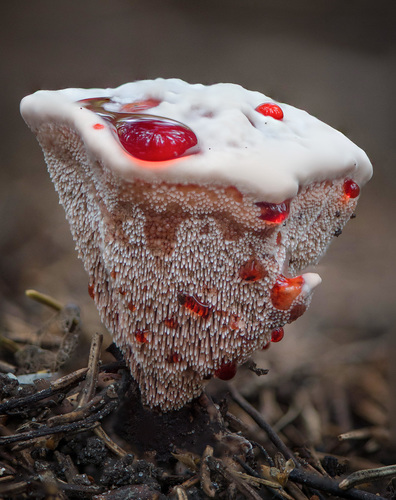
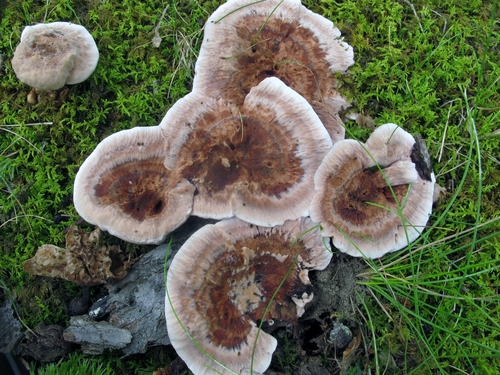
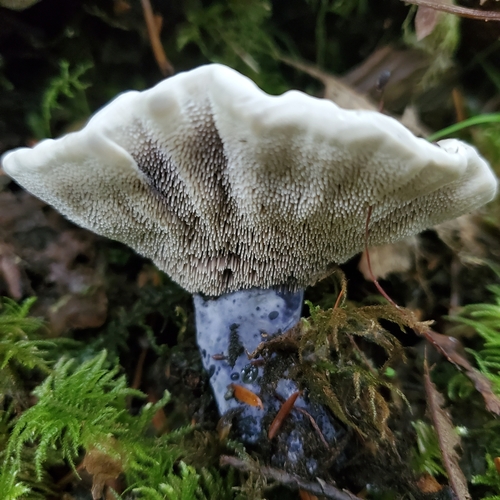
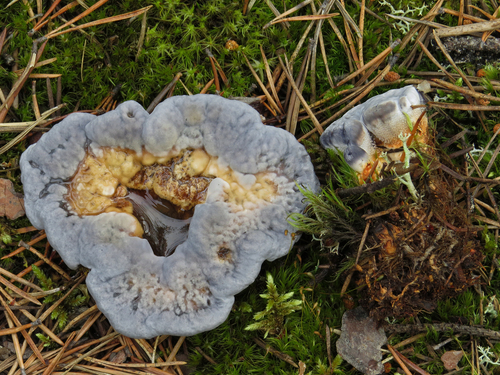
Hydnellum caeruleum is classified within the traditional group of stipitate hydnoid fungi, commonly called stalked-tooth fungi, because of its morphological features: it has a cap, a woody stipe, and a clearly defined toothed hymenium. Its fruiting bodies can grow individually or fuse together with other fruiting bodies in a process called confluence, forming gregarious or concrescent clusters of sporocarps. This growth habit sometimes causes twigs and leaves to become embedded within the fungus’s flesh. The cap, or pileus, of this species is whitish-blue, with a shape that ranges from convex to flat, and it typically reaches around 8 cm in breadth. The cap has a tomentose surface, meaning it is covered in small, dense hairs that give it a velvety texture. The fungus is zonate, with concentric color bands that are sometimes visible on its cap, with colors ranging from white and grayish violet to pastel blue. When bruised, the fungus’s flesh stains dark inky blue. Similarly, the inner flesh appears blue when cut, and fades to a dark gray-blue when it dries. Pale white or gray spines, measuring 3 to 6 mm in length, cover the decurrent toothed hymenium located on the stipe and the underside of the cap. In older specimens, the teeth may turn brown to dark brown. The stipe grows in a central position and is terete, meaning it is cylindrical and tapers in width toward the cap. The base of the stipe is more bulbous, and sometimes develops an orange coloration. Climate conditions can affect the fungus’s color and key identifying features. During periods of high humidity, actively growing caps of H. caeruleum can develop yellow liquid drops. In addition, cool temperatures in late September can cause the fungus to develop deeper blue coloration at this time. Hydnellum caeruleum is a mycorrhizal species, and it is often found growing in humus beneath conifer trees. It is an ectomycorrhizal fungus native to temperate regions of Asia, Europe, and North America. It is commonly found in pine and spruce ecosystems because it forms mycorrhizal relationships with coniferous trees. In these relationships, the fungus receives nutrients from the host tree, and in exchange helps the plant take up water and minerals. This has led to speculation that this fungus plays an important role in forestry. A 2012 study found that stipitate hydnoid fungi such as H. caeruleum can persist in soil for 1 to 4 years after their sporocarps have disappeared, thanks to persistent below-ground mycelium. This persistence of vegetative mycelium was found to be more important for the species’ survival than producing sporocarps for sexual reproduction, suggesting that sporocarps only form under specific favorable conditions. A study of stipitate hydnoid fungi in Scottish coniferous forests, which focused on the conservation status and distribution of fungi in these habitats, recorded an unusual ectomycorrhizal association formed by H. caeruleum. The fungus was found associated with the heather shrub Arctostaphylos uva-ursi at a treeless site, indicating that this species may be able to switch hosts from coniferous trees to shrub species. The study noted this finding is important for fungal and tree conservation, as H. caeruleum could survive even after deforestation and help support eventual reforestation of its habitat.