About Hybognathus hankinsoni Hubbs, 1929
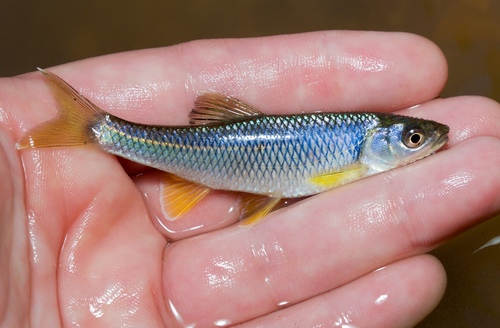
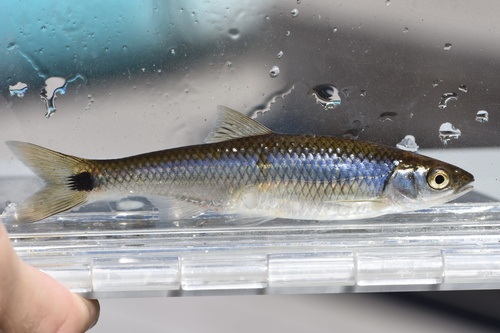
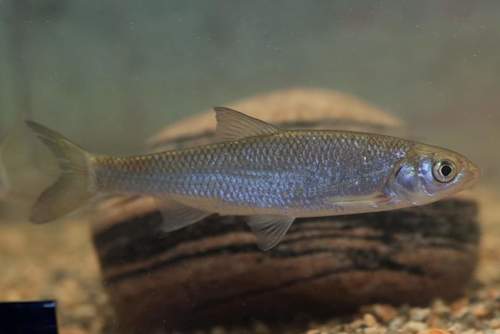
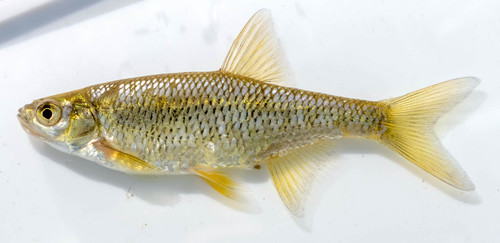
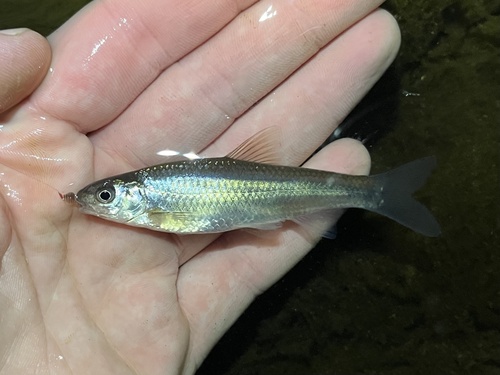
Physical description: The brassy minnow (Hybognathus hankinsoni) is typically 4–7.5 cm long and weighs 0.7–4 g. It can be identified by its brassy side coloration, cream underbelly, and olive green back. It has larger than usual leptoid (bony ridge) scales, and a dark stripe that runs from its gill cover to its tail. Brassy minnows have a small dorsal fin with a rounded tip, and two pelvic fins that lie behind the dorsal fin in the abdominal position. Females tend to be larger than males. Additionally, this species has a small subterminal mouth with a crescent-shaped lower jaw, and its caudal (tail) fin is notched. Distribution: Its range extends from the St. Lawrence River and Lake Champlain drainages, throughout the Great Lakes and Northern United States, and into Alberta and British Columbia. Habitat: The brassy minnow typically lives in cool, slow-moving streams and creeks that have sand, mud, or gravel bottoms overlaid with organic sediment. It is also found in overflow ponds near rivers, boggy lakes, brackish tidal waters, and ditches with weedy bottoms. It tolerates a large range of water pH levels and can survive at low oxygen levels, showing high environmental tolerance; the water it lives in can be either clear or turbid. Brassy minnows appear to do better in habitats with minimal predators, or habitats that have structure for them to hide in, as they are very susceptible to predation. Reproduction and lifecycle: The brassy minnow becomes sexually mature at one to two years of age. It spawns from April through July, depending on location; spawning happens later in the year in the more northerly parts of its range than in the southern parts. Spawning occurs when water temperature reaches 16 to 17 degrees Celsius. The fish lays its eggs on vegetation and along the bottom of the streams and ponds it inhabits. A female can lay up to 2500 eggs, depending on her size, and usually releases the eggs over the course of a week. The eggs take about 7–10 days to hatch, and larvae grow rapidly in their first few months. The brassy minnow lives up to 5 years and spawns annually. This species is considered globally secure, so it has no current conservation concerns.